For today’s post, I’m jumping ahead a little in the story.
Can you picture the scene? You are a follower of Jesus. You’ve just watched from a distance as he was crucified. You saw him die. Then came the confusion – his body disappeared, and you don’t know what to believe anymore. What you do know is that Jerusalem isn’t safe for you, so you’re locked away with others who are just as scared and heartbroken.
And then, suddenly… there he is.
The man you saw die, the one whose lifeless body was laid in a tomb, is standing in the room with you. Is it a dream? A ghost? A cruel trick of your mind?
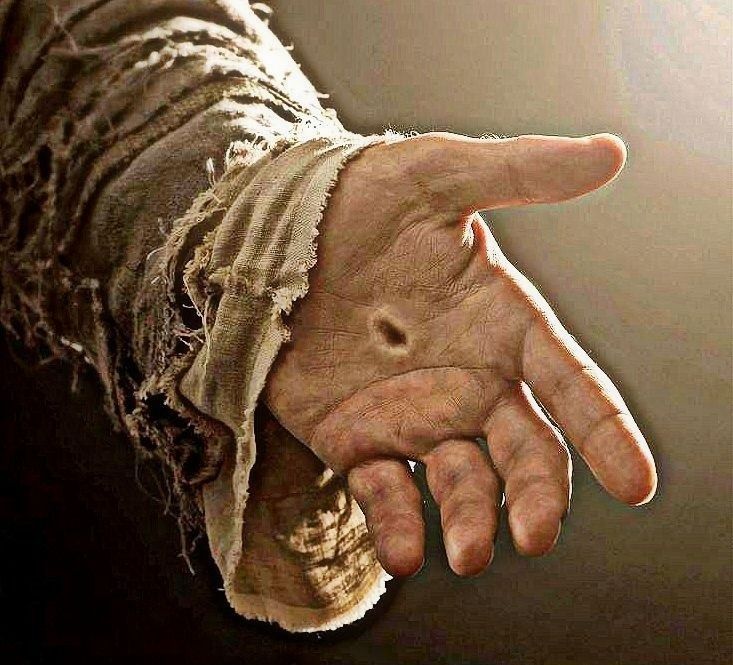
No. Because you see the holes in his hands. The scars where the nails went in. The wound in his side. The marks of suffering are still there, and they are the very thing that convinces you: this is real.
Jesus bears the scars of the cross not in shame, but in glory. He doesn’t hide them. He shows them , as proof of who he is, and of what he has conquered. Proof not only of his death, but of God’s power over death. I often wonder: why didn’t he rise with an unmarked body? Surely, he could have. But maybe the scars are the point. The wounds that once meant death now proclaim life.
And if Jesus – both God and man – carries his scars into resurrection, maybe we don’t need to hide ours either.
At church, we have several people preparing for baptism. Part of that journey is preparing a testimony – sharing a personal story of faith. Last Sunday, I chatted with a couple of them. One was asking others for advice. Another was putting it off altogether. I understood both reactions.
So I shared my own story to encourage them.
Well, a version of it. A polished version. I skimmed over my worst mistakes. I didn’t mention the particularly dark period a few years ago when I felt completely lost, and yet discovered how deeply I could rely on God. And truthfully, since stepping into more visible leadership at church, I’ve felt the pressure to hide those struggles. To be the strong one. The steady one. The one with it all together.
But here’s what I’m learning: the church is not a place for perfect people. It’s a place for wounded ones.
When we share our struggles honestly, we give others permission to do the same. When we talk about what God has done in the midst of our pain, we reveal a God who is still working, still healing, still restoring today. And sometimes, by opening up our journey, God allows others to step more confidently into their own.
There are things from our past that shape who we are, and they don’t have to disqualify us. I’ve come to see how my leadership style – collaborative rather than authoritative – is shaped by my own story. I’m naturally drawn to the ones on the margins: the quiet ones hovering at the edge of the room, the people hiding in the kitchen. I want everyone to feel like they belong, because I know what it feels like to wonder if you do.
I think of someone like Peter, the same disciple who denied Jesus three times, who failed at the crucial moment. And yet, not long after, Jesus meets him on a beach and restores him gently. He doesn’t erase Peter’s past, he reclaims it. “Feed my sheep,” Jesus says. The one who failed becomes the one entrusted with others.
Peter doesn’t lead from a place of perfection. He leads from grace.
We don’t walk alone. And we don’t walk unwounded. But our scars don’t disqualify us, they become signs of resurrection, signs of God’s mercy and strength at work in fragile, ordinary people.
Jesus walked out of the tomb with scars.
So can we.
But – and this matters – we also need to be gentle with ourselves. Some wounds need time to heal before they can be shared. I know I did. There are chapters of my story I still don’t speak about often, and I don’t think we’re meant to shout our biggest mistakes from the street corners. Sometimes, it’s a quiet nudge from God, a sense that a particular moment, or a particular person, might need to hear a part of your story. That kind of sharing can come at a personal cost. It needs wisdom, discernment, and kindness – not just toward others, but toward ourselves too.
Our wounds are personal. They’re sacred ground. And when we do choose to share, may it always be with grace, not pressure, because God’s power is made perfect in weakness, not performance.
“But he said to me, ‘My grace is sufficient for you, for my power is made perfect in weakness.’
Therefore I will boast all the more gladly about my weaknesses, so that Christ’s power may rest on me.”
2 Corinthians 12:9
 The Reason for my Hope Blog