Do you like games? I do, especially board games that pretend to reward strategy while quietly smuggling in chaos.
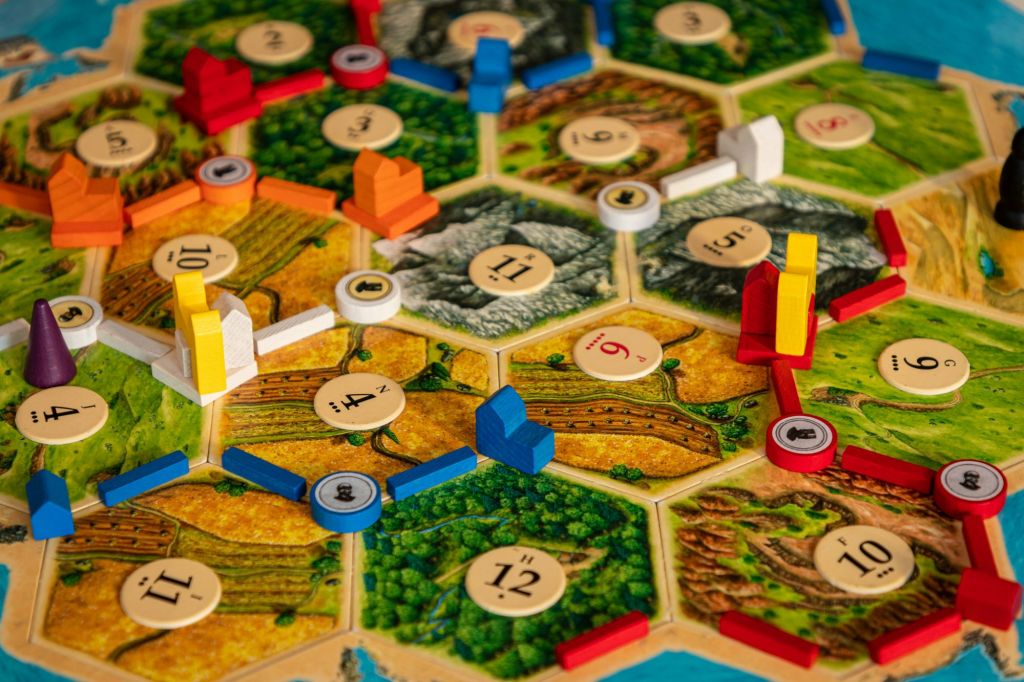
Recently our family favourite has been Catan. The idea is simple: the board is made of different resources, wood, wheat, sheep, brick and ore. Each tile has a number, and when that number is rolled on the dice, anyone settled there collects the resource. You use those to build roads and settlements, trade with other players, and the first to ten victory points wins.
In theory it’s a strategy game. In practice it is a strategy game wrapped carefully around luck.
Take our latest game: I began well. Brick with an 8, one of the most frequently rolled numbers, and soon I had access to wheat, sheep and ore too. Theoretically, a dream start to my game. Except the dice had their own ideas and favoured 3 and 5 instead. My careful planning sat there waiting while probability went elsewhere.
Still, I shouldn’t complain. Of the five of us playing, one player had an awful start. No brick, no sheep, very little wheat, and a 10 on one of her tiles. She spent most of the game trying to trade just to get moving, often without success.
Near the end I realised how stuck she’d been and tried to help, but by then the board was already established. My help didn’t really change much.
I wasn’t being cruel. I wasn’t deliberately refusing. I simply hadn’t noticed.
It sparked a thought: how often life looks exactly like that?
From inside our own story, things feel earned. We made sensible decisions. We worked hard. We planned ahead. Sometimes that’s true. But sometimes we also happened to begin on better tiles.
I realised how easy it is to see only the middle of someone’s story and quietly assume it began like mine. Some people are building cities. Some people are still trying to place their first road. Some generate what they need naturally. Others must constantly ask, negotiate, and depend on kindness just to participate at all. It’s easy to call one success and the other failure when we never saw the starting position.
But what unsettled me most wasn’t that I refused to help. It was that I just didn’t notice. I was fully occupied with my own perfectly reasonable plans. Watching my numbers. Waiting for my resources. Thinking about my next move. The opposite of love is rarely cruelty. More often it is preoccupation.
Jesus consistently noticed people stuck at the edges of the system, the ones unable to move forward without someone else choosing to see them. He did not begin by asking whether they had played wisely. He began by paying attention.
Perhaps generosity starts earlier than we think. Not when we give, but when we look up.
At the end of the evening we packed the pieces away, laughed about improbable dice rolls, and congratulated a gracious winner. But I kept thinking about those starting tiles.
In Catan, helping late rarely changes the outcome. In life, looking up and noticing might.
 The Reason for my Hope Blog