Apparently the game isn’t done teaching me yet…
If you read yesterday’s post, you’ll know Catan has become a popular game with some of my family. It’s also turning out to be a goldmine for theological thinking, so here’s a second reflection inspired by the board game.
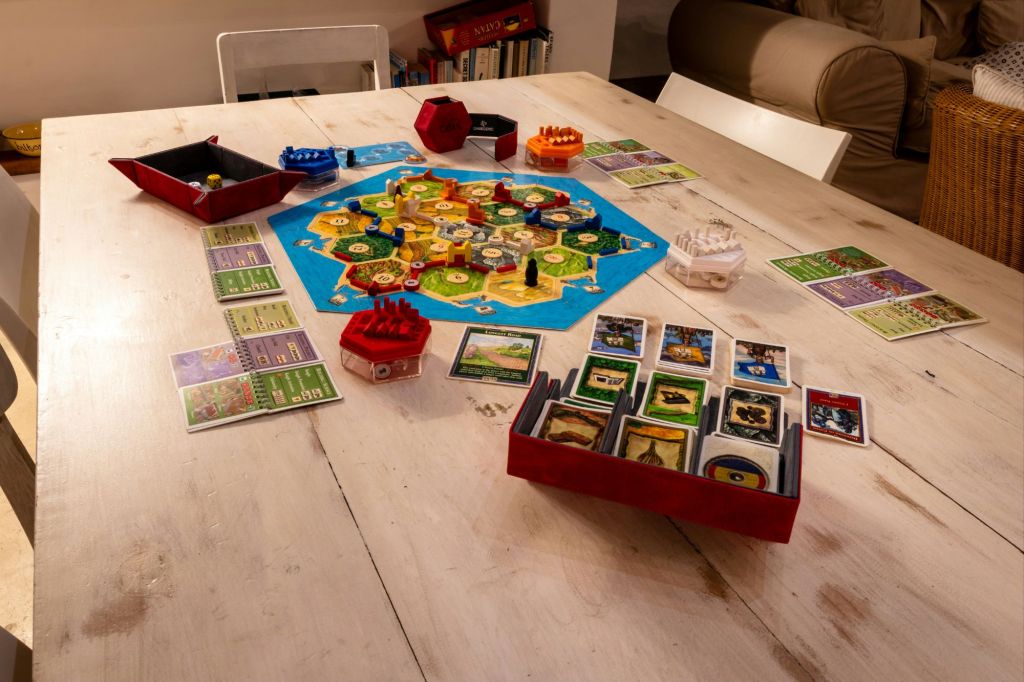
Our games of Catan have a particular rhythm. Not the dice. The conversation. The board fills with roads and settlements, but the real activity happens in the air above it.
“Does anyone have sheep?”
“What areyou offering?”
“I can trade wheat.”
“Two wheat?”
“For one sheep? No way!”
“…fine, one wheat”
There’s a cautious generosity to it all. Trades are rarely pure kindness and rarely pure self-interest. Both players are hoping to move forward. Sometimes several people want the deal and there’s a friendly rivalry as players bid for the resource. Sometimes nobody can help and the question just hangs there for a moment before the turn continues.
Occasionally someone gets left out without anyone intending to exclude them (see yesterday’s post). Mostly, though, the game moves because people keep talking.
You can try to play silently, building only from what the dice give you, but I’ll stick my neck out and say that never works. You stall. The board grows around you. The game carries on elsewhere.
Catan, for all its strategy, probability and luck, runs on conversation. And I think many parts of life do too. We often imagine independence as strength, as though maturity means needing less from others. It certainly felt like that was what society tried to teach me growing up. Yet a surprising amount of human flourishing begins with a sentence that feels slightly uncomfortable to say out loud:
Does anyone have…?
Not a demand. Not even a plan. Just an admission that we cannot progress alone.
It makes me think of Bartimaeus, sitting beside the road while the crowd moved past him. He didn’t wait to be noticed. He called out. Loudly enough to irritate people. Loudly enough that others tried to quiet him. Yet he persisted, because he needed help and believed Jesus could give it. Conversation replaced distance. Attention replaced assumption. His healing began not with sight restored but with a request voiced.
There’s vulnerability in that question. You are telling the table what you lack. You are giving others the ability to refuse you. You are trusting that someone might want your progress as well as their own.
Sometimes the answer is yes. Sometimes it is no. But the asking itself changes the shape of the game.
The communities I’ve seen work best aren’t the ones where everyone agrees or everyone gives everything away. They’re the ones where people keep speaking, keep asking, keep responding. Mutual benefit becomes the normal pattern of life rather than a special act of generosity.
Jesus didn’t only teach people what to believe; he formed a group that needed each other. Meals, requests, shared resources, ordinary interactions. The early church is described as a place where people shared what they had so that no one was in need. They talked, they shared, and that made space for mutual flourishing.
Catan is a game, and everyone is trying to win. But if even a game with only one winner teaches us to communicate and ask for help, how much more important is that in the real world? Perhaps love often looks less like heroic sacrifice and more like ongoing conversation.
A quiet table rarely becomes a community. But a table where people keep asking and answering just might.
So I’m learning not to be embarrassed by small requests, and not to overlook them in others. Sometimes belonging begins with nothing more profound than this:
“Does anyone have brick?”
 The Reason for my Hope Blog