It seems to me that there is a lot of darkness in the world. The headlines are full of violence and injustice, of powerful people taking advantage, of greed and cruelty. And in smaller, everyday ways too: unexpected illness, the breakdown of relationships, disappointments that arrive uninvited.
I won’t lie, there are days when hoping feels hard.
Despite having a public blog, I’m not someone who waves banners or shouts the loudest. I’m more likely to sit quietly alongside someone, offering support. To share skills or knowledge, and then step back so someone else can shine. I don’t mind the spotlight, but I don’t need to hold it.
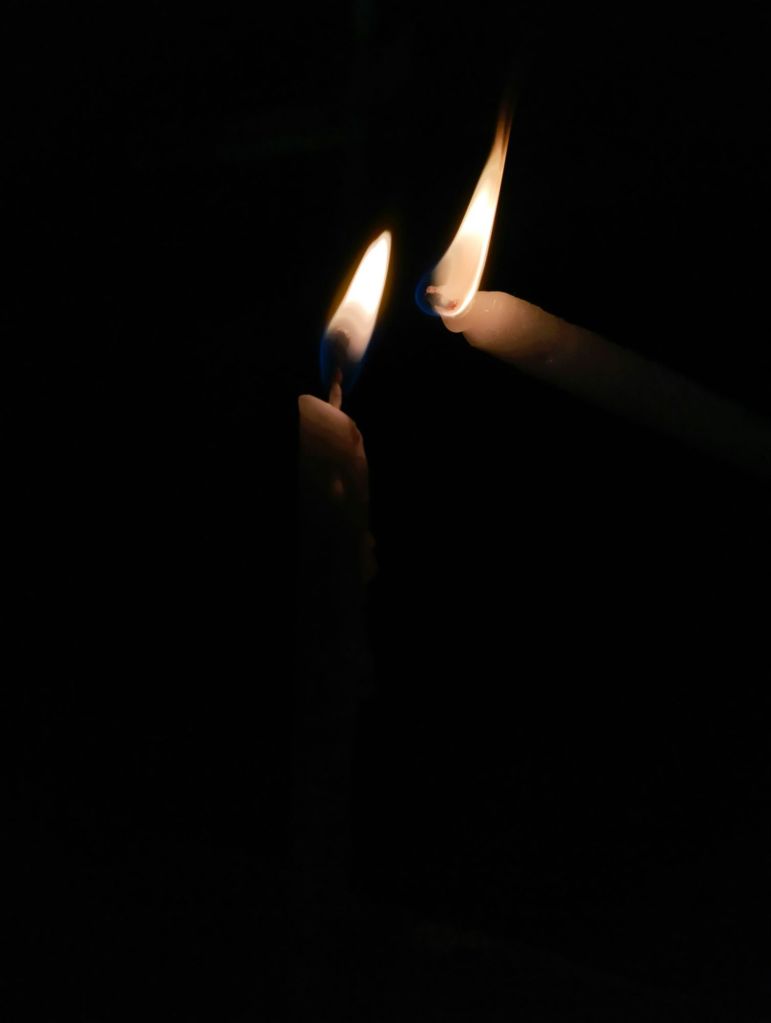
I think of it as the candle effect. If I hold a candle in a dark room, it gives only a pinprick of light. Someone else may stand nearby with an unlit candle. I can guard my flame, afraid of losing it, or I can share it. And when another candle is lit, mine does not grow dim. Instead, the whole room becomes brighter. Not everyone seems convinced of this. Sometimes it feels as though light is scarce, something to be protected or hoarded.
During Lent, we are invited to look honestly at the darkness, both in the world and within ourselves. Christianity has never asked us to pretend that suffering or evil are illusions. The story we follow moves deliberately toward the cross, not away from it.
And yet, at the heart of our faith is this strange and persistent claim: the light shines in the darkness, and the darkness has not overcome it.
Recently, I found myself wondering whether small acts like this really matter. When power and influence are concentrated in the hands of a few, when darkness feels overwhelming, can quiet candle-sharing possibly make a difference?
In conversation, this thought emerged:
Hope is not the belief that the powerful will change. It’s the certainty that they are not the whole story.
The Christian story has always insisted this is true. Again and again, God works not through domination or spectacle, but through what appears small: a child in a borrowed stable, bread broken at an ordinary table, faithfulness that looks powerless beside empire.
When darkness dominates our attention, it can become all we see. Like someone hoarding candles in one corner of the room, the glare draws our eyes until we forget to look elsewhere. But the presence of great darkness does not mean there is no light. It simply means we must learn where to look.
Hope is not pretending everything is fine. Nor is it naively insisting that everything will work out. Hope is more stubborn than that. Hope is choosing, again and again, to live as people of the light. To share what we have been given. To trust that kindness multiplies, that encouragement spreads, that love offered freely reflects something of Jesus himself.
Perhaps hope begins not with changing the world all at once, but with lighting the candle in front of us and trusting that God is already at work in the growing light.
 The Reason for my Hope Blog