At work today, a colleague popped in to say hi and mentioned he was having a “filing day.” He’d been carrying around stacks of paper from various meetings, and it was getting heavy, but now he had a drawer, so he was finally sorting through it all.
I know someone else who always carries a huge rucksack, packed with all sorts of things. Partly to be prepared, partly because it’s hard to sort through everything, so instead, he just lugs it all around.
These are very visible examples of burdens people carry, but the truth is, we all do this in some way. Maybe you’ve known someone with a “Mary Poppins bag,” endlessly deep and filled with everything “just in case.” At school, my bag was always heavy – not just with essentials, but with extra books, because you never know when you’ll have a chance to read!
Do we need to carry all this stuff? Probably not. But somehow, it feels safer to have it with us. Or does it?
There’s comfort in being prepared, but carrying extra weight – physically or emotionally – comes at a cost. Aching backs, sore shoulders, tired feet. And that’s just the physical toll. What about the invisible burdens? The worries we carry for loved ones. The guilt or shame from past mistakes. The fear or anxiety about the future.
For some of us, these hidden burdens weigh so heavily that they crowd out hope, joy, and peace. And just like an overstuffed bag, the longer we go without sorting through it, the more it fills up.
But Jesus offers us a different way.
In Matthew’s Gospel, he says: “Come to me, all who are weary and heavy laden, and I will give you rest. Take my yoke upon you and learn from me, for I am gentle and lowly in heart, and you will find rest for your souls. For my yoke is easy, and my burden is light.”
Jesus models this himself. He travels light, physically and emotionally. He doesn’t cling to possessions, and he shares his worries with the Father in prayer. And he doesn’t add to our burdens, unlike the religious leaders of the day, piling on rules and expectations. Instead, he offers a gentle yoke, a way of living that frees us from the crushing weight of carrying everything alone.
Maybe it’s time to have a “filing day” for our souls. To sort through what we’re carrying and ask: Do I need this? And if not, to hand it to Jesus.
He’s always there, ready to share the load. But more than that, he offers freedom, not just to carry our burdens with us, but to lay down the ones we were never meant to bear.
It feels like there’s a lot of change in my life right now. In the past year, I stepped away from an organisation I’d been part of for seven years. My church came under new leadership, and in the coming months, it will merge with a larger church, bringing a shift in structure and rhythm. At work, we’ve said goodbye to some key people, welcomed new faces, and adjusted to a new person in charge. And as for the future? Well, I’m not quite sure what that holds for me.
I think we all go through seasons like this. Change is inevitable as we and the people around us grow and evolve. It can be exciting or painful – sometimes a mixture of both! We celebrate the new, but we also grieve what we leave behind.
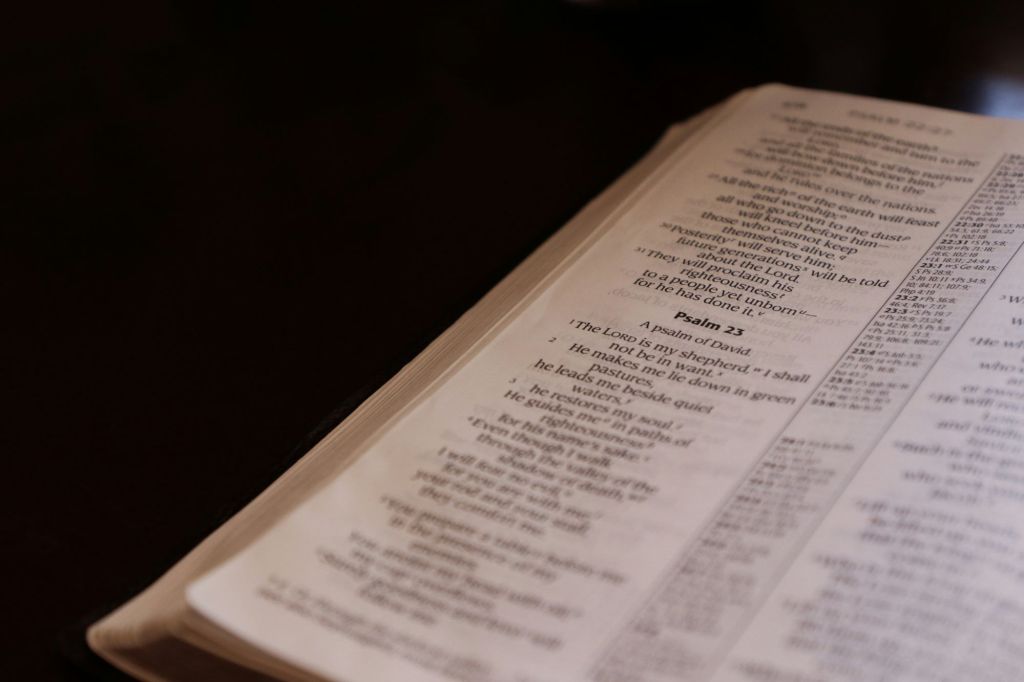
You might be wondering why I’m reflecting on this today. On my Lenten reflective walk, I spent time with Psalm 23, focusing on the theme of trust. It’s a psalm many people in my country know as the “Vicar of Dibley Psalm” (thanks to its use as the TV show’s theme tune). But today, I read it slowly, almost as if I’d never seen it before, letting each phrase settle in my heart. I held a question in the back of my mind: Where do I need to trust God as my shepherd right now?
A few answers came to mind, especially in relation to my loved ones. But as I lingered on the words, I was struck most by the constancy of God. Verse 4 stood out: “Even though I walk through the darkest valley, I will fear no evil, for you are with me; your rod and your staff, they comfort me.”
I wouldn’t say the past year has been my darkest valley, but it hasn’t been an easy path either. As chapters have closed, I’ve had to adjust – to a new way of doing things, to stepping away from familiar spaces, to welcoming new people and letting go of old routines. And yet, through it all, my Shepherd has been there. A steady, comforting presence.
If I’m honest, I’ve sometimes taken that presence for granted. But reading the psalm today, I felt a gentle nudge from God: “You can trust Me. I won’t change or leave. I’ve got you.”
So today, trust and gratitude have woven together in my heart. I’m so, so thankful for the unwavering presence of God, a presence I have always been able to, and will always be able to, trust.
What about you? Where in your life do you need to trust God as your shepherd right now?
I don’t know about you, but life often feels like a mixed bag. One day, everything flows perfectly — like the event I helped with last night. The next, things don’t go quite as smoothly, and that was my experience tonight. I must admit, my first reaction while scrambling to get in control of things, was to focus on the negatives. But as the evening went on, I calmed down a little and realised, while not as smooth as last night, it was still a great event and those who came had a great evening.
We always have a choice. We can choose to focus on the negatives, how we wish it was better, or we can find the positives and celebrate them. There is a passage in Philippians they says ‘Finally, beloved, whatever is true, whatever is honorable, whatever is just, whatever is pure, whatever is pleasing, whatever is commendable, if there is any excellence and if there is anything worthy of praise, think about these things.” And in 1 Thessalonians Paul writes, ‘Rejoice always, pray without ceasing, give thanks in all circumstances; for this is the will of God in Christ Jesus for you‘
Which is all very well and good, but then you add other people into the equation! There are some people who spread positivity. And I don’t mean those who are always happy with false smiles at all times, but those who bring a sense of calm, who acknowledge the reality but also find good points. But there are also those who choose to be negative, who will find something to criticise even at the best of times. Most of us are a mixture of these depending on the time of day, or how hungry or tired we are, or some other circumstance. Sometimes others negativity can be contagious, but sometimes positivity can be just as contagious.
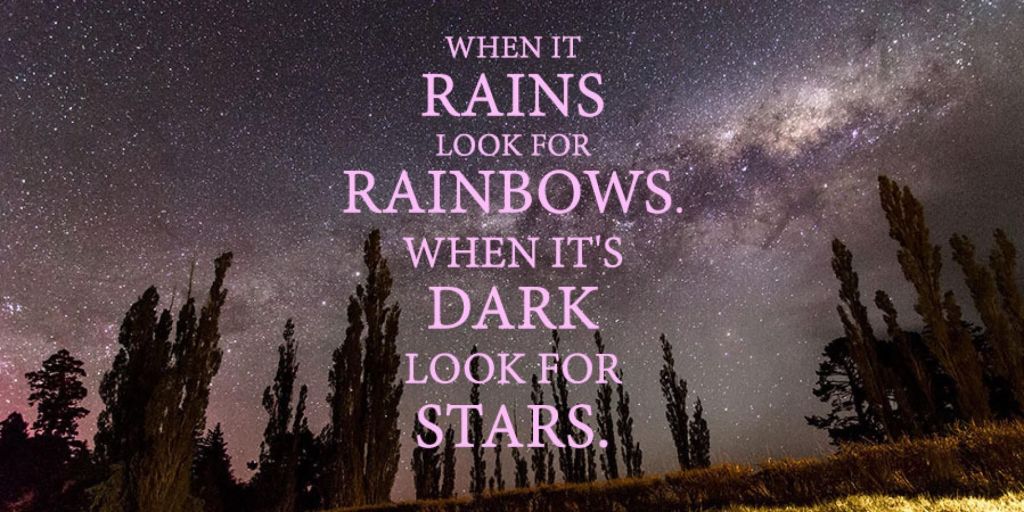
The rest of the chapter in Thessalonians talks about how we should encourage one another, building each other up, and how we should hold onto the good. There is a saying, ‘when it rains, looks for rainbows; when it’s dark, look for stars.’ Now, I don’t mean that we should be naively positive – the rest of the letter to the Thessalonians acknowledges struggles and difficulties – but it is good to practice looking for something positive too. This is something I get wrong a lot of the time, but I’d like to get better.
So next time I feel overwhelmed by what went wrong, I want to practice looking for the stars — those small glimpses of grace that remind me God’s light is still there, even in the dark
This evening was a blast. I was involved in a fundraising quiz for work – well, actually, I organised it. And it was absolutely fantastic! There was a real buzz in the air, everyone seemed to have a good time, and it all went without a hitch. But my favourite moment came halfway through.
For a little while, I could sit back and watch. The kitchen was serving up crumble, the raffle and tombola were being run by colleagues and volunteers, the quizmasters were taking a well-earned break. Like a well-oiled machine, everything was working together.
At the end of the evening, in typical British fashion, the quizmasters, the head chef, and I were caught in a cycle of congratulating each other – each trying to pass the credit on to someone else. You know the situation: “Thank you, you really set the tone.” “But you did the hard work.” “Yes, but we couldn’t have done it without them.”
It got me thinking. First, how wonderful it is to be part of a team so eager to build each other up that this conversation happened sincerely. And second, how each of us brought different gifts to the table.
I could stand at the door and welcome people because I knew reliable hands were running the raffle. The kitchen team knew where to send the food because I’d set up table labels. I could relax, knowing the food would be excellent. The quizmasters could focus on presenting, balancing the need to get through questions with giving teams time to think – and adding a little light-hearted banter. Meanwhile, they trusted me to get the questions on screen and tally the scores.
It sounds pretty basic written out like that, but in reality, with all these things happening at once, it felt like a tapestry – each thread contributing to the whole. Take one part out, and the tapestry loses something, or even starts to unravel.
So yes, it’s good to congratulate each other. But you know what? It’s also okay to accept the congratulations from others.
And so it is on a larger scale. Each of us has different skills and gifts. By combining them and working together, we create the richest, most beautiful tapestry. It’s like Paul says in 1 Corinthians – a body has many parts. An eye shouldn’t compare itself to an ear, because they each serve a different purpose (my paraphrase).
When we compare ourselves to others, we miss the beauty of diversity – and often diminish our own contribution, or theirs. But when we encourage one another’s gifts and have the courage to step into our own, wonderful things happen. Tonight was a great example of that for me.
Tonight reminded me that life works best when we lean into our gifts and trust others to do the same. Whether it’s running a quiz, serving up crumble, or simply showing up with a smile, every thread matters. And when we weave them together, the result is more joyful and vibrant than any of us could create alone.
Phew! Reached the end of day! It feels like I packed a lot in. In fact, a lot of days feel like that at the moment. Can you relate? We have a house calendar so we know who is in (and how many to cook for) and there are some weeks that I’m not home any evenings because of meetings or rehearsals or other engagements. And work! I do love where I work, but sometimes there is just so much to do!
Why am I saying all this? I’m sure there are plenty of people out there who are busier than me! I’m saying this because when I got home from work today, before heading back out to choir, I sat in my car. I didn’t exactly plan to, but I got home, took the keys out the ignition, and stopped. After a full day, and knowing there was more to be done, it was wonderful to take a moment to just be still. I once read that sitting in your car outside your house is a form of self care. Today, I understood that sentence.
Looking back, I realise I do that more than I realise. Taking a breath before entering a room. Lingering after prayers or meetings. Stopping to watch a sunset or listen to the birds. On the best days, I go to ‘my spot’ and look out over the hills, listening to nature and enjoying the sun. Sometimes only for 10 minutes, but those are 10 precious minutes.
In the bible, again and again, Jesus withdraws to pray and spend time with God. It is from a place of rest and intimacy with God that Jesus does his ministry. I’m not as good at the withdrawing as I could be. But what I can do is allow those moments of pausing within my day, not always pushing on to the next thing. Yes, it is good to get away, and planned retreats are part of a healthy rhythm of life, but within everyday there are opportunities to pause. And the wonderful thing is that God meets us in them, even if we don’t realise it. I love those times in ‘my spot’ because I look at and listen to and feel God’s creation. But even those moments to breath, the lingering steps, the stopping and sitting, God is in them too.
I recently read about a contemplative missionary called Frank Laubach who wrote a book called ‘The Game with Minutes’. I haven’t read the book (yet!) but the premise is he invites the reader into a spiritual practice where they think of God at least 1 second of each minute. I’d love to get better at that, at pausing and intentionally bringing God more into my day. Maybe next time I get home, I won’t be in such a hurry to get out and put the kettle on. Maybe I’ll sit for a moment longer, breathe a little deeper, and remember that God is present — even in the pause.
Lent 2025 starts today, and with it a period of reflection. This year I’m trying something new: combining scripture and the outdoors for some reflective, prayerful walks. My plan is to do at least two a week.
Today I started with Psalm 51. If you aren’t familiar with this one, it’s a psalm of repentance. I read it through and set off, mulling over some of the phrases. What struck me most was the complete dependence on God. The psalmist brings all their faults, all their wrongdoings, to God, knowing that only God has the ability to wipe them away completely. God’s judgment is final, but in His mercy, He makes us clean when we ask for it. And that’s the second thing that stood out — the psalmist knows he can ask for forgiveness.
When we face people who might hold things against us, blame, or ridicule us, it can feel safer to hide or shift blame elsewhere. But to come before someone, open and vulnerable, asking for forgiveness, suggests deep trust. The psalmist shows that trust — he knows God is the only one who can truly cleanse him, and he knows God is willing to do so. That’s really quite remarkable, and a powerful place to start this Lent.
Something else struck me while I was out. Do you ever look up at the night sky? What do you see? Today’s walk was quite late, so it was dark, and the night was clear. My route took me through an area with little artificial light. Something else struck me while I was out. The clear night froze my fingers, but it also revealed the stars. I love looking up at the night sky, but so often, I can’t see much because of light pollution. But tonight, away from the man-made street- and house-lights, I could see the stars and the moon in all their glory.
Reflecting on Psalm 51, this felt like a living metaphor. It’s easy to get distracted by the artificial — the busyness and noise of life. But when we step away from the glare, we encounter something genuine and authentic. Likewise with God — we’re surrounded by things that try to fill a gap, but when we pull back from the noise and distractions, we come face to face with the real, authentic God. I can come, as I am, with no masks, nothing artificial, and know that God wants me, faults and all. And God, in His mercy, won’t hold it against me when I get it wrong.
Looking at the stars, I was reminded to be honest and real — because God’s creation is breathtaking, and His love is even more so. So, taking my lead from the writer of Psalm 51, knowing I am not perfect, I will spend some time this Lent acknowledging my own faults and reflecting on God’s grace and mercy.
Happy New Year! We are now a week into 2025. Have you decided on any resolutions? Have you kept the ones you have made?
I don’t make resolutions. Or, I don’t make New Year Resolutions. The pressure to be original and the lack of hope that I will actually stick to them put me off. Instead, I ask God for a word for the year; a word (or phrase) which gives me a clue about what is to come, a word or phrase I can come back to as the year progresses, a word or phrase which I can reflect on at the end of the year and realise God did way more than I expected.
In the past, my word for the year has been trust (involved moving house and a new job), surrender and grace (that was an interesting year!) and last year, the word was renewal. Looking back, I renewed some friendships, renewed some passions and renewed my passport(!), but there was also renewal on a deeper, more personal level. Off the back of the summer trip to Taize, I had a renewed relationship with God. And across the year I discovered more about myself, and got a renewed sense of who I am and who God made me to be. In other words, it’s been a fruitful year, and having a specific word has helped me to see it.
Why not give it a go? Ask God for a word for this year, then watch as the meaning is revealed. It has enriched my faith, maybe it can enrich yours.
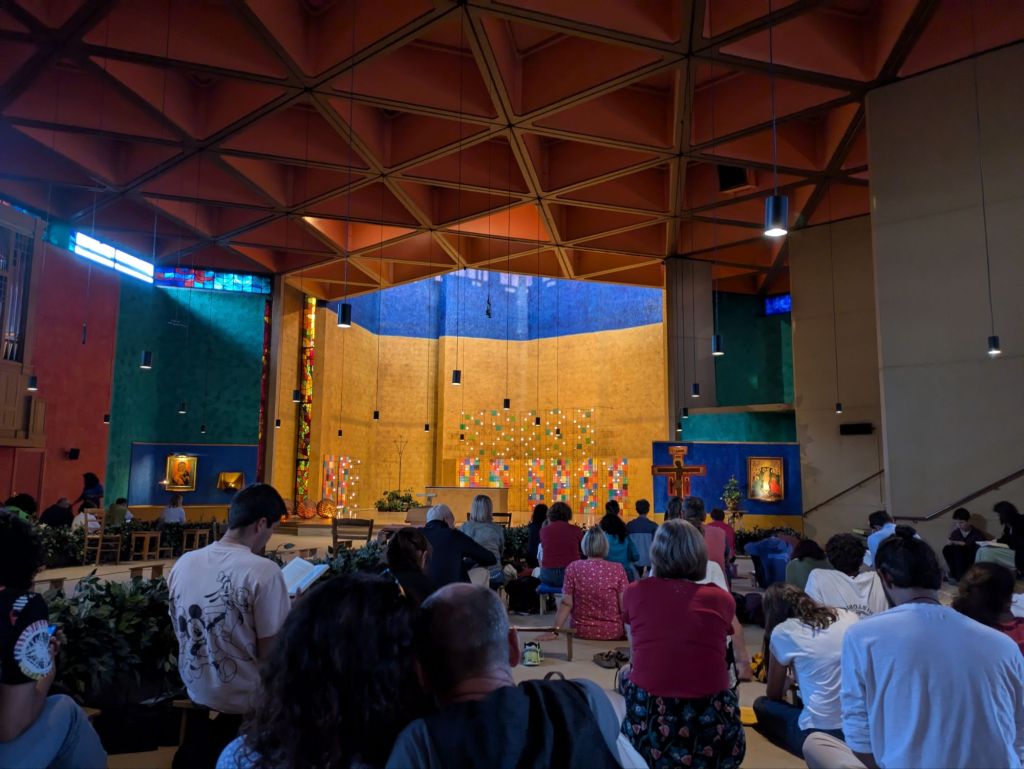
As I write I am watching the sun rise over the hills surrounding this french community (quite a feat for someone not normally a morning person!) I am coming to the end of a week at Taize.
For those who don’t know, Taize is a religious community in France, slightly north of Leon. It was started in the 1940’s by Brother Roger and continues today as a place of pilgrimage and retreat, especially for young people, served by a community of Brothers. Taize is particularly well known for its chants – simple short verses of music sung repeatedly, with words like a prayer in many different languages.
That’s a snapshot overview, and about as much as I knew before I arrived.
What can I say about my week at Taize? On practical matters, the beds in the dorms were good (can’t speak for those camping) and the showers were decent (but good idea to get to them soon after they’re cleaned!) The food was pretty simple, and for those with dietary requirements (like me) sometimes disappointing. The benches for sitting on became uncomfortable very quickly, and the floor in the church took some getting used to.
But you don’t go to Taize for the food. And you don’t go for luxuries – it’s not a hotel or a summer holiday! It’s a place to seek God, a place to serve together, a place to worship.
Speaking of worship, visitors are asked to enter and leave in silence, creating a prayerful atmosphere. Coming from an English church, it was refreshing to be able to sit in quietness and still my mind. And the singing – wow! Taize gathers together people from across the world. As a way of honouring the cultures, there are chants in most languages. They are short enough and simple enough to be picked up by everyone. And I found myself singing in English, French, German, Spanish, Polish, Russian and some I couldn’t identify. Joining in with over a thousand voices singing the same words over and over was quite an experience. Someone explained that by singing the chant repeatedly, we are encouraged to go deeper rather than go on, which goes against what we are used to. There were translations written underneath each chant and while singing we could reflect on the short statements, meditating on the words and allowing the message to penetrate deep into heart and mind. And occasionally, to stop and listen to the other voices, basking in the harmonies and marvelling at the beauty of the sound. A friend I met there described it as being held by a warm embrace. I think that is a good description of an experience I’ve not found anywhere else.
Each morning one of the Brothers taught on a passage from the bible before sending us off in small groups to continue the discussion. We listened to Brother Paolo share his wisdom, balancing historical fact and biblical context with modern day stories and application. His sense of humour made it fun and drew me in, even making the benches bearable. He gave us some little nuggets that resonated with me (and may find their way into future posts!) and allowed us to look at the passage with a fresh perspective in our groups.
I was truly blessed with the small group. There were 4 of us from across England who hadn’t been before, 1 from Germany who had been once before and 2 from France who were seasoned veterans of Taize, calling it the ‘best place on earth!’ Using Brother Paulo’s talk and our own experiences, we had some brilliant conversations, and in a way only possible in such circumstances, found ourselves trusting each other quickly. I really hope to stay in touch with the very special people from that group.
We were also given the opportunity to meet with the Prior, Brother Matthew. After Evening Prayers we were taken to the garden in the Brothers side of the compound. Brother Matthew joined us and pointed out the moon just beginning to rise over the distant hills. We then sat in silence and watched the moon rise. It was a reminder to me to enjoy the simple joys and keep watching for beauty.
For me, Taize was a spiritual realignment. The experiences and busyness of the last year had left me weary, and serving others in the way I have been had left my own relationship with God a little neglected. Taize was a chance to stop and re-evaluate, a chance to receive the love and friendship of others, and a chance to turn back to the right track, putting God first. The whole experience was a reminder to look at the bigger picture. The food wasn’t great, but at least I had something to eat. The seats were uncomfortable, but at least I had the time and freedom to sit. Sometimes the storms in life threaten to overwhelm, causing us to take our eyes off of Jesus and start to drown. This week was a nudge to look again, to focus on the blessings rather than the storm.(I know that’s easier said than done, but it’s good to be reminded that we have a choice about how we view things)
They say no one leaves Taize unchanged. I can tell you from what I discovered there, that’s true. But don’t take my word for it, make the journey and experience it for yourself.
It’s Easter Saturday, the day between Jesus’ crucifixion and Jesus’ rising. I have a number of friends who have already put up their colourful Easter wreaths, who have already started wishing others “Happy Easter”, even my t-shirt says ‘Spoiler alert! The tomb was empty!’
None of these are bad things – we live in a world where Jesus has risen, where we know the end of the chapter. But as we read the story in the bible, Jesus dies on the cross and is buried, and then we skip a day and it’s the day after the Sabbath. One gospel says on that middle day the Romas posted guards so that no one could tamper with the body. Another says that because it was the Sabbath, Mary and the other women rested. So Easter Saturday is quick to jump over.
And in life, it’s easy to overlook ‘Easter Saturdays’. We want to do something, fix something, jump to the next good thing. Some would say we have a culture of impatience.
But, reading between the lines, Easter Saturday is hugely important. We hear how the disciples couldn’t stay up and pray with Jesus, maybe not understanding what Jesus was trying to tell them or realising the significance of what we now call the ‘Last Supper’. We hear of them resisting Jesus’ arrest but then running scared. We hear of Peter’s denial, of John and the women standing near the cross weeping. We hear of Roman soldiers jeering then one changing his mind about who Jesus was.
And we hear that Jesus died quickly. Not quickly enough to avoid suffering – I’m not downplaying what Jesus went through – but crucifixion was a slow painful suffocation and victims would push themselves up on their feet to enable themselves to breath only for the pain to get too much (if they were nailed) or their strength to give out and they would slump once more and struggle to breath, this drawing out the end as they naturally fought to stay alive. The others crucified with Jesus had to have their legs broken to hasten the end. But Jesus was already dead. I haven’t studied this in great detail, but to me that suggests that Jesus didn’t fight the inevitable, he didn’t try to prolong his life. He accepted it, as he did in the Garden when praying, as he did when he didn’t resist arrest, as he did when he didn’t defend himself on trial.
But then we are quick to jump to ‘the disciples rose early and found the tomb empty’ skipping over a day of waiting, a day of silence. I would guess it was a day of disappointment, of lost hope, of seemingly broken promises as the one who was sent to save now lay dead on a tomb. A day of heartbreak and uncertainty as a man they had loved and trusted was now gone. It’s an uncomfortable day, a day of silence and waiting, a real test of faith, a day when negative emotions may have surfaces – paralysing fear, overwhelming guilt, unimaginable sorrow.
We are blessed to know the next bit, but Jesus’ followers at the time didn’t. They didn’t have anything to distract them – they couldn’t work on the Sabbath, they didn’t have TV or games, they just had each other in the grief. Can you imagine it? Everything you had pinned your hopes on torn away as you watched helpless?
Let’s not skip over the day of waiting, keen as we are to celebrate Easter. Let’s join the disciples waiting in silence. And as we wait, try thinking about what Jesus did, willingly and lovingly. I imagine it’s not easy to face that sort of death with the courage to that Jesus did, to be in such pain and still find the strength to cry ‘Father forgive!’ But that indicated the strength of his love for us.
Aware I have 2 day’s musings to write up, I am nonetheless pushing forward to write today’s musings. They are musings triggered by a sermon I heard yesterday. Well, part of it.
I was visiting friends and we went to their church, so the voice at the front was new to me. They started with an image and some thoughts around that before moving on to their main point and there was a lot of wisdom, but it was that initial picture that captured my imagination.
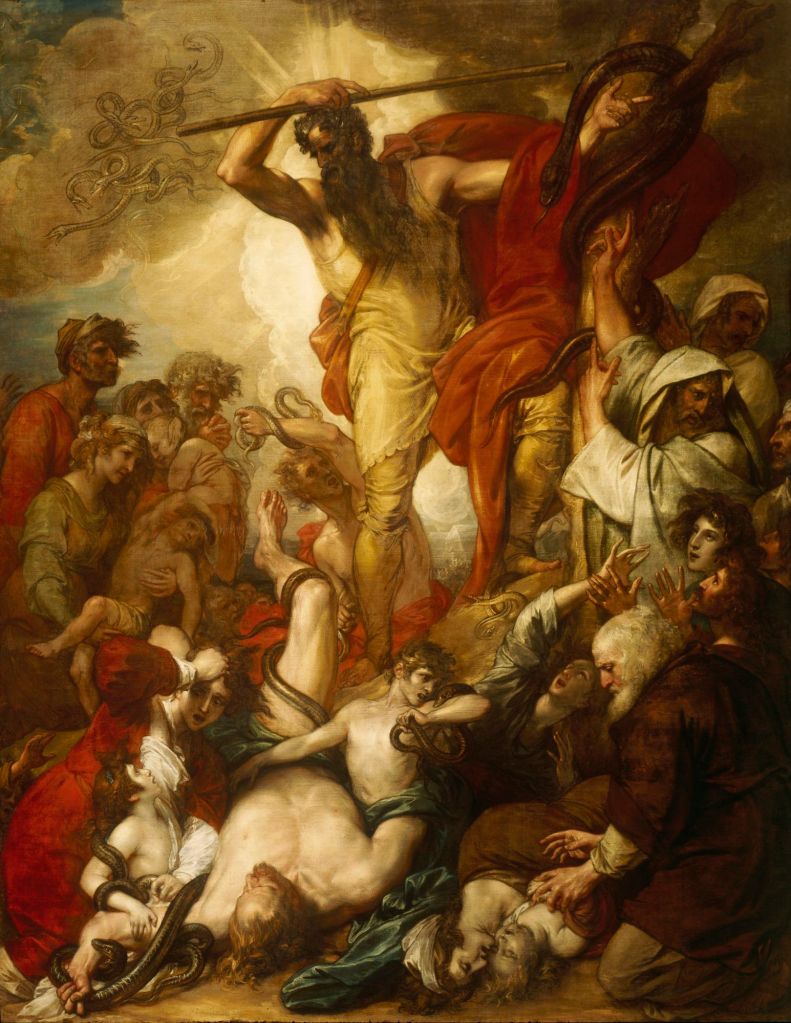
The picture was a medieval depiction of a passage from the book of Numbers. I can’t find the exact image online (if I do stumble upon it, I replace the one below) so I have gone for a similar one. The passage it is based on is during the time that Moses was leading the Israelites through the wilderness. They had escaped from Egypt but hadn’t yet reached the promised land. They had been grumbling because they were hungry and in general it seemed that morale was low. The bit that’s relevant comes in chapter 21. The camp is invaded by venomous snakes. The Israelites didn’t have a cure, so if they were bitten it was a death sentence. They called out to Moses who looked to God. God instructed him to make a bronze serpent and put it in the centre of camp where all could see it. When bitten, the Israelites had only to look at the bronze statue and they would be healed.
In the image we were shown, there was indeed a serpent on a pole in the middle. And Moses stood just to the left with a stick pointing to the serpent. But in the background on the right there was a man with a stick who appeared to be trying to beat the snakes – he was taking the role of protector on himself and judging by the number of snakes, failing. In the same sort of area there was a figure who had been bitten and someone next to them embracing them, comforting them. They had taken the healer role, although it didn’t look like it was going much good. In the front right was another figure who had just been bitten, and they seemed to be looking to Moses, the visible person who had been leading and ‘providing’ for them – he was putting his trust in man, not God.
The thing is, the instructions given by God were simple: look at the bronze serpent. They didn’t need to waste energy trying to beat the snakes to death, they didn’t need to offer false comfort, they just needed to look at the snake.
It got me thinking, how often do I hear God’s instructions and say, ‘I hear you, but I think I should…’? How often do I disregard the simple reliance on God for my own skills, my own actions? How often do I look to people instead of God? How often do I complicate things instead of simply following instructions? What if I just trusted God’s plan?
It definitely got me thinking, and I wonder if it will prompt you to think about your choices too. God is a lot more capable than we are – maybe we should try trusting him.