2024 40 days of lent: day 8 – Car Crash

On my way to rehearsal this evening, someone drove into the back of me. Coming up to a roundabout, the car in front of me stopped to let a pedestrian cross, I had time to stop but the car behind me didn’t. The noise was the worst bit, but no one was hurt, the car in front drove off as they weren’t affected, and there was minimal damage to the cars.

When we got out and exchanged details, and the driver said that really it was the driver in front of me’s fault, the one who had stopped for the pedestrian, shame we didn’t catch their details.

What does this have to do with God? This seems to me to be a good allegory for how life can go. In this situation, I had done everything right – I was paying attention, I had left a good stopping distance, my lights were on – in fact, there was nothing more I could have done to prevent this.

In life, we can do everything right. We can be kind and respectful, we can be generous and charitable, we can be good citizens and human beings and still find ourselves in trouble. It’s not all to do with us. Other human beings can make a mistake or choose to act in a way that is not as generous or kind. In this situation, for whatever reason, the driver behind me didn’t stop in time. But what was worse for me was the way they didn’t take responsibility, but instead tried to pass that onto a third party. Again, a parallel with life maybe? The one in the wrong trying to pass the blame?

God gave humans the freedom to choose. Sometimes we choose to do the right thing, sometimes with the best of intentions we get it wrong, and sometimes we just make bad decisions. And so often, innocent people get hurt, either physically or through wrongful persecution.

God never promises this won’t happen. In fact, the psalms are full of the psalmist lamenting the fact that those doing evil seem to be rewarded while those who are good suffer. But what God promises is that he will be there with us, and that what is to come is better. He promises his own justice in eternity, and that is a merciful justice that we can trust – God sees more than us and loves harder than us and there is no one else I would want to judge me.

So when those metaphorical car crashes come your way that you couldn’t prevent, it’s not a punishment for something you have done ordained by God, but God is there with you, telling you to breath, making a strong cuppa, giving you a hug, and God will see justice done, his justice. You can trust him, he’s got your back.

2024 40 days of lent: day 6 – New every morning

The other morning I was up early. I’m not usually a morning person, but on this particular morning I was up and active early (and slightly tired). And I got the opportunity to see the sky change from dark to slightly grey and then a glorious sun rise. It was beautiful and breathtaking – clouds in various shades of pink above the houses and the sun crept over the horizon against a light blue sky.

Just over an hour later, the sky was dank and grey, and half an hour after that it was raining, but that moment of sunrise was picture perfect (except my pictures never quite do nature justice).

A book I don’t often quote, Lamentations, says: Because of the Lord’s great love we are not consumed, for his compassions never fail. They are new every morning; great is your faithfulness.

It got me thinking about how we don’t always see the sun, and sometimes it is grey and rainy, but the sun is always there. Each day is different and out of our control, but God is a constant – like the sunrise, God is always there. How amazing is that?!

It doesn’t matter whether we’ve messed it up or if things have been thrown our way, each day is a chance to start over and try again. God doesn’t hold our past against us so we should let it go too.

If you aren’t a morning person, I would recommend setting an earlier alarm to see the beauty (and soon because the sunrise gets earlier when the clocks change!) If you are regularly up early, pause and take in the sunrise, don’t take it for granted. And remember as you do that each day is a new opportunity to experience God.

2024 40 days of lent: day 5 – For God so loved the world…

John 3:16 is one of the most well known and frequently quoted bible verses (in my experience, I haven’t done a detailed study!) It says, ‘God so loved the world that he sent his only Son that whoever believes in him shall not perish but have everlasting life.’

It is a good Bible verse, especially when praying for someone – it is good reminder that we are all loved. There are others. 1 John 3:1 ‘See what love the Father has lavished on us that we should be called children of God’ is possibly my favourite.

The limitation of the John 3 verse is the condition that can sometimes be read into it – that we must believe before we are loved. 1 John 4, a few verses later than the one I just quoted states, ‘We love because he first loved us’. The love comes first. Before we have done anything, said anything, become anything, we are loved. After we have stumbled, made a mess, been scarred, we are loved. God’s love is bigger than anything else, it’s a theme that runs all the way through the bible. You are loved.

The other day I came across the picture at the end of this post and I had a lightbulb moment – we are all loved and we will never meet someone who isn’t. The best or the worst of us is a Child of God. Sometimes that may be hard to swallow, and sometimes that is a huge comfort. God’s love for us is unconditional – it’s about who he is, not what we’ve done. Take a moment to think about that and let that sink in – you will never meet someone that God doesn’t love.

2024 40 days of lent: day 4 – Time Out

My brain is a little fuzzed this evening. The way things have worked out recently, proper days off don’t come easily, I have to properly plan them in. I’m sure I’m not alone in that. It is so easy to be tempted into working, either for our paid job if we are fortunate enough to have one or for somewhere we volunteer our time. In fact, it is almost cultural to be busy all the time, and taking time out can feel looked down upon.

But Jesus took time out – he often retreated to spend time in prayer and his disciples had to go looking for him. And in the creation story, God set a day aside to rest and look over all he had done. Constantly doing stuff is not a biblical principle and also probably isn’t healthy.

Being busy is a good escape and distraction from things we don’t want to face. It is a good way to give ourselves a sense of worth and accomplishment, albeit temporary. But the thing is, we can’t keep it up forever. Sooner or later something will come up that is outside of our control – maybe we will end up ill, or the place we are being busy at will be closed for some reason – and we will find ourselves with time in our hands and those things we’ve been running from catch up, or our sense of worth has nothing to latch on to and we plummet emotionally.

The psalmist says time and again to rest, to ‘Be Still’, to ‘Wait for the Lord’. Maybe what some of us need this lent is to slow down, to take time out. Listen to your body, listen to your brain and listen to your heart. If anyone of them feels tired or ‘fuzzy’, maybe you need to take a Time Out and refresh yourself somehow, with a coffee, and good book, a walk – something that is definitely not work.

If Jesus could find time to take a Time Out, I think we should make time too.

2024 40 days of lent: day 3 – those who’ve gone before

Jesus lived 2000 years ago. (I know, technically Jesus lived from the beginning as still lives now, but his earthly life was 2000 years ago). In the time since his death, resurrection and ascension, there have been millions if not billions of people who followed him and his teaching, commonly called Christians.

In some Christian traditions, some of these Christians are especially important – they have lived a life that was virtuous and holy and pointed to God. They are grouped together as Saints. A large number of the Saints appear to have been martyred, although I haven’t studied them all.

For this tradition, the Saints can intercede on our behalf and therefore are prayed to in certain circumstances – for example when travelling, St Christopher may be prayed to as patron saint of travel. This is not a tradition I was brought up in or taught about, but I have friends that it is important to, so I asked about it. They had a couple of responses:

Intercessors

We often ask our friends and communities to pray with and for us. Praying to the saints is like that – asking other Christians to pray with and for us. This is a principle in the bible which Paul talks about when writing to give advice to other churches.

Prayers of the righteous

Following on from that, in James’s letter, he writes about the power of the prayers of the righteous. The saints in heaven definitely come under that category, so it makes sense to ask them to intercede.

Learning

This was my favourite response: they have lived such interesting lives and can teach us so much – we would be missing out on so much to ignore them. This is the reason for my bog post today. The Saints have led interesting lives, come up against all sorts of trials, have lived in the real world, made mistakes and still left a legacy that points to God. They come from all backgrounds, all nationalities, all ages – they are all so wonderfully different like us. Their stories are so rich and they have so much to teach about living in step with God.

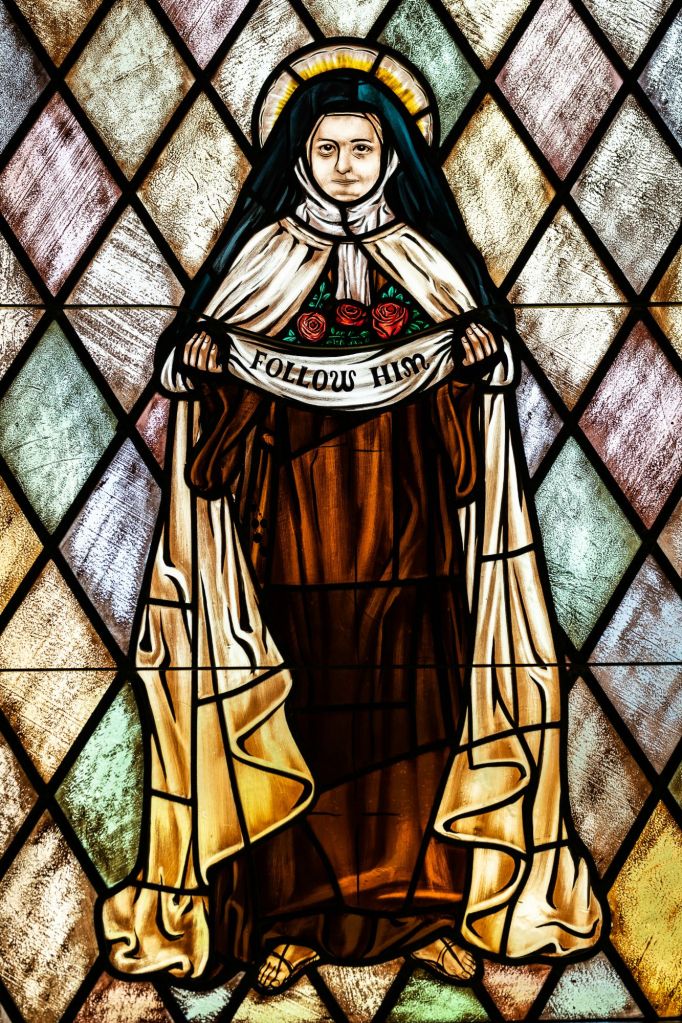
Growing up in a church, I wasn’t always great at listening to the sermon, but from my seat I could see a stained glass window with St Martin, who saw a beggar by the roadside and cut his cloak in half to share with the man who had nothing. It’s still one of my favourite stories. St Francis and St Clare were rich nobles who gave everything up to follow Jesus. Contemporaries in the same area, they ministered differently. Francis travelled around to spread the gospel, Clare set up an abbey for girls to join her and dedicate their lives to God.

The Saints offer us a rich tapestry throughout history of people who lived their lives for God, who didn’t have it easy but chose to do it anyway. If they could walk through their trials and still lean on God, then so can I. I have a book of Saints through lent – one saint a day, just a snippet and what that may teach me – and I am looking forward to the lessons God will teach me through it.

Do you have a favourite saint? Maybe there are a couple whose stories can inspire you. If you are looking for a way to grow closer to God this lent, why not try looking at these Christians that history has remembered as good examples of followers of Jesus?

2024 40 days of lent: day 2 – Muted

It is said that if a person loses one sense, the others become sharper to make up for it. Someone who is blind will often be able to discern more through hearing and smell than someone who has all their senses. On a smaller scale, someone who is trying to concentrate on what they are seeing or reading might block their ears somehow, or someone who wants to concentrate on a taste or smell might close their eyes.

By ‘muting’ one sense, our other senses have the capacity to process more meaning they become more effective. A similar thing happens in a church in lent. Traditionally, the colours are more muted (although the purple often used today doesn’t always fall under the muted category…), flowers aren’t used to brighten the building, wordy ‘Gloria’s’ are replaced with simpler ‘Kyrie’s’ (Lord, have mercy) and ‘Alleluia’s’ used to decorate verbal worship are dropped until Easter. Without these elaborations, as wonderful and joyful as they are, the church enters a more sombre period with a sharper focus on relationship with God and what is getting in the way. It is often a time of prayer and fasting, of repentance, of turning around and returning to God.

By muting other area of our worship and other distractions within the building, we can more clearly focus on rebuilding an intimate relationship with God. Jesus has already made that possible through the events of Good Friday, we just need to empty our hands and grasp it.

Are there distractions around you that you need to mute temporarily? Are you holding things that are stopping you embracing the relationship God wants to have with you? What can you do to change that?

2024 40 days of lent: day 1 – Happy Galentine’s

Becoming a helpful tradition for me in lent, 40 days of drawing closer to God through writing. As ever, some will be long and some will be snapshots, but all will be God focused in some way.

This year, Ash Wednesday, the first day of lent, has fallen on Valentine’s Day. Me, my housemates and some friends (all single) used it as an opportunity to celebrate a different kind of love.

Sometimes there can be a pressure from well meaning people, be that families, churches or friends, to find the right person and settle down (however that may look). But that is a societal pressure rather than a God pressure. In fact, in his letter to the Corinthians, Paul writes that it is good for the unmarried to stay single like him, but if they can’t exercise self control then they can marry! That’s almost the opposite of what society tells us today!

I think there is room in the world for couples and singles, for both to be happy and accepted. God created people to live together in community and created different types of love to describe those relationships.

So if today, you and your significant other did something special, that’s wonderful, and I hope you both felt truly loved and made memories together. And if you don’t have that significant other, I hope you know how loved you are by the people around you.

And remember, God loves you more than you could possibly imagine and there’s nothing you can do to forfeit that. Is there something you can do over the next 46 days to draw closer to God and discover more about how he feels about you?

The gift of choice

It’s Easter Saturday. A day of stillness, and the beginning of the celebrations that Jesus is not dead. It is a time of joy. If you choose to believe…

Reflecting back on the Easter story, it strikes me how much choice plays a part. I don’t mean Jesus’ choice to endure the cross in order to save mankind, that still boggles the mind. I mean the choice to turn to Jesus or not.

Peter and Judas, both betray Jesus. Judas leads the soldiers to him, Peter denies knowing him and abandons him. Peter chooses to run towards Jesus, searching for mercy. Judas chooses to run away from Jesus, searching for an escape.

Two criminals are crucified along with Jesus, one on his right and one on his left. Both are rightly fully convicted of a crime. One chooses to mock Jesus, speaking perhaps out of fear of dying, or maybe anger at the circumstances. He mocks Jesus, challenging to save them all. The other points out that they deserve their fate, Jesus doesn’t. Then he asks Jesus to remember him. He chooses to accept instead of challenge.

All four of these men made bad choices. But two of them also made good choices – they chose Jesus. The other two… well, they didn’t choose Jesus.

We also have a choice. When we make a bad decision, we can let it consume us or try to run away from it. Or we can chooses Jesus, turn to him for mercy and grace. He won’t force us. He let’s us choose to run. But he will be waiting with open arms if we choose to return. Just look at the story of the prodigal son.

So whatever bad decisions you have made or will make, one good decision can wipe them out. Peter and the repentant criminal found that out. Follow their example. Choose Jesus.

Brutal – lent 2023

I’ve spent quite a little if time today listening to and reflecting on the story of Jesus’ death. The only way I can describe it is brutal.

Jesus shares a meal with his closest friends. He shares bread and wine and some last advice, then he gets in his knees with a towell and washes their feet. In less than twelve hours they have fallen asleep when they should have kept watch, run away when danger looms, one has betrayed him for money, one has denied him out of fear. The friends he led and served all abandoned him. Brutal.

He gets tried by the high priests. People make up stories about him. They want him dead so hand him over to the Roman official asking for the death penalty. He is stripped, whipped and beaten. The lashes leave marks and draw blood. The beating leaves him bruised and weakened. His hands are tied he can’t defend himself. Brutal.

The soldiers humiliate him. They mock him with a purple ‘robe’ and a crown of thorns they push down on his head, drawing more blood. It runs into his eyes but with hands still bound there is nothing he can do but sit there and take the mockery. Brutal.

Back in front of the Roman official, the crowd who had cheered his arrival in Jerusalem turned on him. They choose to give freedom to a murdered instead of him. Rather, they call for him to be executed in the most painful and humiliating way on offer: crucifixion. The crowd who had loved him now call for his death. The Roman official, fearing a riot, washes his hands of Jesus’ fate and turns away. Jesus is alone and helpless again. Brutal.

Jesus, already bruised, bloodied and weakened, is made to carry his cross through the streets to the hill of execution. Not just the cross bar, but the whole thing. The crowd jeers at him, they spit at him and the soldiers are all to ready with their floggers. He falls, collapsing under the weight of the cross and the flogging, but the crowd don’t help. Except one. Simon of Cyrene shares the burden, the insults, the whipping. He carries the cross with Jesus. And the insults continue and the beatings continue and Jesus still has to carry the cross up the hill. Brutal.

Once there, he is laid out on the cross. The soldiers get nails and a hammer. They line up his hands and his feet and drive the cruel iron nails through the delicate flesh. They pull his arms tight but bend his legs slightly so that when he is upright he has to choose whether his arms or his legs hold his weight as he slowly suffocates. Then he is hoisted skywards and displayed for all to see. The so-called Messiah, broken and humiliated, nailed to the cross. Brutal.

And let’s not forget Mary, his mother. She was there at the cross. Who knows how much more of this ordeal she saw. As a parent, she wants to protect her child. But she is helpless, watching on the sidelines as the future she has always known and possibly always feared comes true before her eyes, worse than she could ever have imagined. She sees his broken body. She sees the pain in his eyes, hears it in his voice. And she can do nothing but let it happen, nothing to stop her heart breaking. Brutal.

Already in a weakened state, Jesus doesn’t last long on the cross. When the soldiers break the legs of the others crucified, they declare Jesus already dead and don’t break his. But just to be sure, the pierce his side with a spear, doing further damage to his body. But mercifully, he is already dead. His suffering is finally over.

So when you hear the phrase, “Jesus died for you”, I urge you not to dismiss that as a nice thought, as a kind gesture. That is how much you are loved. Jesus chose to bear that for you. He endured pain in every imaginable way, he suffered, and he would do it again. For you.

You are important. You are loved. You have been saved. Because Jesus went through with this brutal death. For you.

WWJD – lent 2023

Today we held a Maundy Meal at church. We heard the account of the last supper from John’s Gospel and we ate together. We didn’t have a full blown passover meal. Instead, we had some delicious home made soup with bread, cheese and fruit. We also didn’t wash anyones feet.

The gospel says how Jesus tied a towel around his waist and washed the feet of his disciples. This was something a servant or slave would have done – they all walked in sandals and so their feet would become dusty from the roads. So it is tradition on Maundy Thursday to emulate that in the service. It has always struck me as strange. Partly because our culture doesn’t normally do that so it seems an odd thing to do, and partly because I’m fairly sure that anyone who volunteered to have their feet washed had made sure they were clean before leaving the house and defeating the object of the exercise! There are plenty of churches that still do this symbolic act and plenty of people who find it helpful to participate in.

I remember one year at church we had a Maundy Supper where we washed the hands of the person next to us. I remember it very well because I was quite young, possibly 6, and the jug was quite heavy and I ended up dropping it and making some rolls very soggy! But culturally, washing hands makes more sense – a lot more people wash their hands before eating than wash their feet where I live.

But this evening, while we were eating, it was suggested we discuss what Jesus would be doing if he were around now. Different ideas were thrown around. Some focused on the hospitality side: having someone wash your feet was a sign of welcome and respect. Maybe Jesus would take our coats, or bring a chair so we could take off our shoes. Some focused on service: washing feet was a servants job, not a leaders. Maybe Jesus would serve the drinks, or maybe he would be washing the dishes.

Maybe what he would be doing doesn’t matter as much as why. Jesus gave an example for his disciples to follow, that they should go and do the same. That we should go and do the same. So we should wash everyone’s feet?

I don’t think it’s that simple. I don’t think it’s the action, I think it’s the heart. Jesus, their Lord and teacher, lowers himself in status to fulfil the role of a servant. He shows that he is willing to love and serve in a manner society would say is below him.

So what would Jesus do (wwjd) today? I don’t know. But I think it would be something that would make people sit up and listen, something that went against the status quo. Maybe he would offer to wash our feet. And I know he would send us away to do the same.