Today I took a break from study and watched an episode of Firefly, a ‘space-western’ TV show from 2002. The series follows the crew of a spaceship who take any job that pays, even if it is technically against the law. (They have their own moral code so are definitely the ‘good guys’)
In the first episode, they pick up some passengers. One of them, Shepherd Book, is a bit like a modern day monk, a religious person who has lived in community. He sets out to explore the world and, seemingly at random, ends up on our hero’s ship. It’s an eventful voyage, and this holy man ends up knocking out a man of the law, then vows to protect him, realises he’s on a smuggling ship, then watches as the man he vowed to protect gets shot by the captain (remember, definitely a good guy).
Towards the end of the episode, he is talking to the mechanic. He’s thoroughly disillusioned, and says, “I think I’m on the wrong ship.” The mechanic replies, “Maybe you’re on exactly the right ship.”
How often in life do we set out full of excitement and expectations only to find reality is different from what we imagined? Sometimes it’s easy to get disillusioned, to think we made a mistake and want to ‘get off’ or turn back. But looking back on my own journey, it’s those times when I’ve felt ‘on the wrong ship’ that I’ve grown the most, that I’ve learnt the most about God and myself. God has used those times to teach me, to push me out of my comfort zone.
The next time things don’t go the way you expect and your feel like you’re ‘on the wrong ship’, remember the words from Firefly – maybe you are on exactly the right ship. Keep going, you never know what God will show you.
This year I have been greedy; I have two books to read and reflect on through lent. I guess unsurprisingly they both use the passage of Jesus being tempted in the wilderness.
Both books gave me plenty to think about, but for today I want to go back to the passage. I read through Matthew 4.1-13 slowly. It’s a passage I’ve heard and read more times than I can count, so I wanted to make sure I really read it rather then assuming I knew the passage.
The thing that struck me most was what the tempter says to Jesus. He says, “If you are the Son of God, then…” Immediately before being sent to the wilderness, Jesus gets baptised and God calls out from heaven, saying “This is my Son, whom I love.” 40 days later, this is the first thing the tempter attacks. “If you are the Son of God, prove it.”
I wonder how often we are tempted to question God? Or how often we doubt our own identity as God’s children? How often does the world try to tell us something different from what God tells us? And when any of these things happen, how do we know what to believe, or who to trust?
Jesus pushes back by quoting from his religious text, what we now know as the Old Testament. Hungry and weary as he might be from 40 days in the wilderness, he chooses to trust in the sacred texts, and in the God they reveal, the God he knows.
It can be tempting at times, easier and more attractive, to listen to those voices, the ones that encourage us to doubt God or ourselves. It can be simpler to trust the voices of the world. That little question, if, can lead us down unhelpful paths.
I don’t know if I would have had the strength that Jesus did, to not give into temptation and instead to choose to trust God. The good news is that Jesus did resist, and in doing so showed us the way.
My encouragement for you (or maybe challenge) as we embark on Lent 2026 is that God’s word is trustworthy and reliable. In the bible, we have a gift to help us through the hardest times, words that reveal who God is, stories that tell us of Jesus’ example. So maybe set aside a little time each day and read the bible. Spend some time in one book, read it slowly and see what God prompts in you. And when those ‘ifs’ come calling, you might just find, like Jesus, that you have an alternative to rely on.
This week always feels like an odd one to me. Christmas Day has been and gone, and New Year’s Day is not yet here. The busyness and preparation have all paid off, and now there is a pause, a period of in between. For me, it’s a time of reflection. Reflecting on the year that has been: the triumphs and the hardships, the memories made and the lessons learned. And also beginning to look ahead – to hopes, goals, and expectations for the year to come.
It’s in this reflective space that I ask God for a word for the year ahead. It’s a practice I’ve found deeply helpful. Each time, a word or phrase comes, and as the year unfolds I gradually realise just how apt it is, usually in ways I could never have anticipated. This time last year, the word God gave me was Jubilee.
For me, 2025 has been an interesting and exciting year. It hasn’t been an easy one; there have been plenty of frustrations and tears along the way. And yet, it has been a year that has deepened my faith. This year – seven years after initially being told I wasn’t ready – I was accepted to train for ordination. A calling I had all but given up on was given back to me.
This year also required me to acknowledge some deep, inner pain caused by a couple of people from my past. I had to name it, sit with it, and ultimately let it go. Forgiveness is not some sentimental ideal we aspire to; it is a biblical calling, and it is hard! But it is also necessary if we are to keep growing and moving forwards. Resentment and bitterness become chains; forgiveness, however costly, sets us free.
It has also been a year of endings and beginnings. Of leaving the comfortable and familiar to step into something new, exciting, and slightly daunting. That has meant geographical distance from good friends and familiar places, alongside the gift of meeting new people and forming new friendships.
Looking back now, this is what Jubilee has meant for me. Not fireworks or grand celebrations, but renewal, restoration, and the quiet cancellation of debts. It’s not what I expected when God first gave me that word a year ago. And yet, as I sit and reflect, it feels exactly right for what God has been doing in and through my life.
Because that is the heart of it. None of this happened because I worked hard enough to make it happen. I didn’t earn any of it – not the triumphs, and not the challenges either. This has been about God’s timing. The uncomfortable struggle with forgiveness came when I had the people around me to help me face it. The journey to ordination training came when my trust in God mattered more to me than the outcome; when my eyes were fixed on God, not on myself.
So 2025 has been a Jubilee year for me, not because everything was easy, but because God has been faithful. Faithful in restoring, faithful in challenging, faithful in teaching me to trust. I step into the year ahead without all the answers, but with a deeper confidence in the One who calls, restores, and leads in his own time. And that, I am slowly learning, is what Jubilee really looks like.
“He has made everything beautiful in its time.” (Ecclesiastes 3:11)
I’ve just returned from a week in Taizé, the community of brothers in France who welcome thousands of young people and pilgrims each year. This was my second visit – different from the first, and yet somehow the same. Different people, same God. Different theme, same rhythm. Different worries, same peace.
As I journey home, the songs of Taizé are still with me. They play like prayers on repeat, carrying the memories of the week and the people I met. Four in particular stand out.
Laudate omnes gentes, laudate Dominum
Sing praises, all you people, sing praises to the Lord.
There is something both humbling and heart-warming about sitting among more than two thousand people from all over the world and singing these words together. Different languages, different traditions, different lives – and yet one song, one faith, one God. That’s Taizé.
Confitemini Domino, quoniam bonus
Give thanks to the Lord, for He is good.
Gratitude became a theme of the week for me. Even the journey there – which was almost cancelled when our coach got cancelled ten days before we were due to travel – became something to give thanks for. Determined not to miss the week, a small group of us cobbled together an alternative route: an early morning lift to Dover, ferry to Calais, three trains across France, and finally a bus to the village. We pitched tents in the dark, weary but relieved.
It could have been a disaster, but instead it became a story of provision, resilience, and grace. By the time we sat in worship singing Confitemini Domino, I realised just how much I take for granted – and how much I truly have to give thanks for.
Nada te turbe, nada te espante; quien a Dios tiene nada le falta. Sólo Dios basta.
Nothing can trouble, nothing can frighten. Those who seek God shall never go wanting. God alone fills us.
The most profound moment of the week came after one of the evening prayers. Brother Matthew, the Prior of Taizé, invited a young Ukrainian man to speak.
He told us about separation from his family. About the daily uncertainty of living in a war-torn country. About clinging to fleeting moments of joy in the midst of so much pain. This wasn’t a distant news story; it was a first-hand testimony. His voice broke, but his faith was unwavering. And then he finished with words that undid me completely: “Thank you for your prayers. Thank you for not forgetting us.”
“Nada te turbe, nada te espante…” Nothing can trouble, nothing can frighten. To sing those words with two thousand voices after hearing that story? The power of faith and hope. It genuinely brought tears to my eye.
Nimm alles von mir, was mich fernhält von dir. Gib alles mir, was mich hinführt zu dir.Lebendiger Gott, nimm mich mir und gib mich ganz zu eigen dir.
Take everything from me that keeps me from you. Give everything that brings me near to you. Living God, take me away from myself and give me completely to you.
This final song was new to me, but it struck deep. After hearing stories of war and loss, after conversations about abuse, injustice, and brokenness, this simple prayer felt like both a cry and a commitment.
It is a cry to draw nearer to God, to share the faith and trust I glimpsed in those whose lives are marked by suffering. But it is also an invitation – to be used by God, to long for peace, to work for justice, to offer myself for the healing of the world.
I return from Taizé the same, and yet different. The songs stay with me, weaving themselves into prayer, shaping my longings, deepening my faith.
And so I end with the words of that final song, which have become my own prayer:
“Nimm alles von mir, was mich fernhält von dir. Gib alles mir, was mich hinführt zu dir. Lebendiger Gott, gib mich ganz zu eigen dir.”
Take everything from me that keeps me from you. Give everything that brings me near to you. Living God, take me away from myself and give me completely to you.
Today is Holy Saturday. Traditionally, a day of stillness and silence between the devastation of Good Friday and the triumph of Easter Day. It’s interesting to wonder how the disciples would have felt. The whole world has changed, and yet life continues. Would they have been thinking back over the last few days, wondering what went wrong, what they could have done differently? Would they have felt numb, knowing a beloved friend and teacher was gone and they’d never see him again? Were they thinking back, comparing stories of the good times and the lessons he had taught? I guess we’ll never know – the bible skips over that part.
But for us, it’s gives space to reflect. I know for me, Holy Saturday is a day when I try not to make any plans, enjoying the opportunity to catch up with loved ones and just to have some space to myself. But I’ve also found myself reflecting on the journey of the last week. My key themes for this Lent were grace, gratitude and trust, and they seem fitting companions to reflecting on the events of Holy Week, especially viewing the events through the eyes of grace.
Just a week ago, I wrote about the joy of Palm Sunday. Jesus rides into Jerusalem to shouts of “Hosanna!” But Jesus knew he was approaching the end. Luke 9:51 says, “Jesus resolutely set out for Jerusalem.” He knew, even as he was hailed a champion of the people, that they would turn on him. And yet he chose to go. Grace meets us even in the midst of celebration – quietly, intentionally, walking towards sacrifice while others wave palm branches in triumph. It is grace that walks willingly into pain for the sake of love.
Skipping ahead a few days, we reach Maundy Thursday. Jesus shares a final Passover meal with his friends, sharing food and drink even though he knows one will betray him, one will deny him, and the others will abandon him. He ties a towel around his waist and washes their feet. Grace shows itself as Jesus humbles himself to do a servant’s work, knowing that not one of the men around that table deserves it. Grace doesn’t wait until we are worthy, it meets us as we are. It bends low, washes feet, and offers love in the face of betrayal.
And later, in the garden, Jesus kneels before God and cries out in desperation, hoping for another way but knowing there isn’t one. He submits, trusting God even at this darkest point. Grace doesn’t mean the absence of fear or struggle. It means choosing to trust and surrender, even when the cost is everything.
Then comes Good Friday. Jesus is beaten, mocked, and crucified. And even on the cross, we see grace in action. Jesus prays for forgiveness – for the soldiers who crucify him, for the crowd who turned on him, and even for us, whose sins he carries. In his agony, he still looks outward. He shows mercy to the criminal beside him, promising paradise even though there’s no time left to prove repentance. He entrusts his mother to John, ensuring she will not be left alone. Grace doesn’t falter in suffering. It pours itself out, even when there’s nothing left to give.
And now we arrive at Holy Saturday. The day of silence. The in-between. The day when it looks like grace has failed. But grace isn’t gone, it’s waiting. Working in the unseen. Grace holds space for grief and stillness. It doesn’t rush to the resolution. It allows the weight of sorrow to be felt. It holds us when we don’t know what comes next.
Maybe that’s where some of us are today – not yet at Easter morning, but waiting in the dark. If that’s you, know this: grace is here too. Grace sits beside you in the silence. Grace holds on, even when we can’t. And tomorrow, grace will rise.
Today, for a Good Friday service, we were exploring the last seven sayings of Jesus from the cross. I was assigned the fifth saying, “I thirst,” and asked to speak for five minutes on it.
At first, I wondered how on earth I was going to talk for five minutes about just two words. But within half an hour of starting to research, I was wondering how I’d ever manage to cut it down! In the end, I had three reflections I could have given and picked the one that felt right in the moment.
But it felt a shame to let what I’d learnt stay with me, so I decided it was worth sharing here too – a Good Friday blog post for a small but profound saying.
“I thirst.” Two words that are so simple, yet hold within them raw vulnerability. On the verge of death, with cracked lips and a parched throat, Jesus calls for something to drink.
This moment is recorded in John’s gospel, and John is always keen for his readers to see Jesus as the fulfillment of Old Testament prophecy. He points us back to Psalm 69: “They put gall in my food and gave me vinegar for my thirst.”
There are so many layers here. On one level, this is a cry of human suffering, a physical need. It reminds us that Jesus truly experienced pain. He didn’t float above it all with supernatural detachment. He felt it. He thirsted.
But this moment also shows us Jesus’ obedience. He knew the Scriptures. He knew what was foretold. He knew what he had come to do. Even in agony, Jesus continues to fulfill the mission he has embraced, right to the end.
I found myself wrestling with the tension between those two ideas. If Jesus only said “I thirst” to fulfill Scripture, does that somehow make the suffering feel staged, less real? Or if this was simply a cry of pain, does that mean the fulfillment was accidental?
But I think the beauty of this moment is that both are true. Jesus doesn’t perform suffering – he lives it. And in living it, he shows us a love that is both deeply human and divinely faithful. His obedience doesn’t lessen the pain. And the pain doesn’t dilute his purpose.
There was also a third layer I began to explore.
Last night, during our Maundy Thursday Watch in the Garden, the leader invited us to imagine something different as we read the account of Jesus in Gethsemane. She said: What if, rather than just imagining Jesus ministering to us, we imagined ourselves ministering to him?
That thought stayed with me.
Because when I returned to the cross and heard “I thirst,” I remembered those words from Jesus earlier in his ministry: “Whatever you do for the least of these, you do for me.”
The cry of thirst didn’t end on the cross. It echoes through time.
It’s there in the parched throats of those without clean water. In those in refugee camps, hospitals, war zones. In those denied dignity, care, or even their basic needs. The voice of the crucified Christ still speaks: “I thirst.”
And maybe part of our calling – as his followers – is to listen. To respond. To quench that thirst where we can. To minister to Jesus, hidden in the brokenness of our world.
So today, as we hear the cry “I thirst,” where do we see Christ still thirsting in our world, and how might we respond?
It’s been another busy day. This morning we held a Chrism Mass – a service where the oils used for anointing are blessed, and clergy and lay people have the opportunity to renew their vows of commitment to God. There were hundreds of people on site; the car park was full, the congregation sang with gusto, and the whole place was buzzing with (good) chaos.
So when I stepped out of my office that afternoon into the sun, I paused. The crowds had gone, the site was quiet, and there was a calm stillness in the air. I just stood for a moment, letting the sun warm my face, and noticed a genuine sense of peace. A peace that settles in when the storm has passed, if only for a moment.
After work, I went to a simple said evening service. As we sat quietly in the chapel, we could hear the wind outside and the bustle of preparations in the main part of the Cathedral – the organ and choir rehearsing for the later liturgy. And yet, in that chapel, in the presence of God, there was peace. Not silence, but stillness. Not the absence of sound, but the presence of calm.
It reminded me of a story I once heard: a king holds a competition, asking artists to paint a picture of peace. Many submit idyllic scenes – sunsets, still lakes, green fields. But the winning entry is different. It shows a stormy sky, crashing waterfall, and wild waves. And there, tucked beneath a rocky cliff, is a small bird in her nest, calm and secure. That painting won because it captured true peace; not the absence of trouble, but peace in the midst of it.
That idea resonates with me. The “calm lake” moments in life are rare and fleeting. More often, I’m surrounded by noise, deadlines, activity, and distraction. So remembering that peace can still be found in the middle of it all feels like a lifeline.
Tonight, on Maundy Thursday, I’m struck by the contrast between two responses to Jesus in the hours before his death. There’s the woman who anoints him. She breaks open an expensive jar of perfume, pours it on him, and wipes his feet with her hair. It’s a moment of pure, extravagant devotion. The disciples are shocked at the waste, but Jesus defends her. “She has done a beautiful thing,” he says. “She has prepared me for burial.” In the growing storm, she brings honour, tenderness, peace.
And then there are the disciples. They fall asleep in the garden when Jesus asks them to stay awake and pray. When the guards come, they run. And Peter – bold, beloved Peter – denies even knowing him. In the thick of fear and confusion, they abandon him.
One brings presence. The others scatter. One acts in love. The others act in fear.
I don’t judge them. If I’m honest, I see myself in both responses. Some days, I pour out what I have, kneeling at the feet of Jesus with peace in my heart. Other days, I fall asleep. I disappear. I deny. And yet, even in those moments, Jesus still moves toward the cross in love. For the woman, for the disciples, for me.
Because the peace he offers isn’t dependent on my performance. It’s found in his presence. It’s the peace of a bird in a nest, while the storm rages on. It’s a peace that holds.
Continuing my discovery of the additional themes of Holy Week, today is known, in some traditions, as Spy Wednesday – the day we remember Judas Iscariot making the choice to betray Jesus. A far cry from the glory of James Bond or Jason Bourne, here the term spy means to ambush or snare. It’s an uneasy name for an uneasy story. A man who walked with Jesus, heard his teaching, saw the miracles, shared meals and laughter, choosing to sell him out for silver.
Even before the events of Holy Week, Judas used to steal from the common purse. He’s not exactly your poster boy for Christianity! It’s easy to keep Judas at arm’s length. To cast him as the villain. To say, “I would never.”
But would I?
I don’t have a situation as a direct comparison, but what about the times I don’t choose Jesus? When I choose comfort over compassion. When I stay silent rather than speak truth. When I grasp for control instead of trusting God. When I walk my own path and pretend it’s the faithful one.
None of these look like thirty pieces of silver. But they are still small betrayals – of trust, of love, of who I am called to be.
And yet, here’s the mystery: tomorrow at Maundy Thursday, Jesus still washes Judas’ feet. He still calls him friend. Grace doesn’t flinch, even at betrayal.
Spy Wednesday is an invitation to us – not to wallow in guilt – but to look honestly at our own hearts. To ask, where am I turning away from Jesus, even quietly, even in the shadows? And then to turn back to remember that grace is still extended, even here.
Even to me.
Even to you.
A Prayer for Spy Wednesday
Lord Jesus, You knew betrayal, and still chose love. You saw the shadows in Judas—and in me— and knelt to wash feet anyway. Search my heart, and where you find fear, pride, or turning away, draw me back with grace. Teach me to walk your path, even in the dark. Amen.
Today, I found out that traditionally on the Tuesday of Holy Week, we remember Jesus in the temple – teaching, challenging, confronting. It’s an interesting passage on the way to the cross. It shows a different side of Jesus. The tension is rising. The cross is coming. And yet, Jesus doesn’t back down.
Combining the account from the 4 gospels, we find Jesus speaks truth to power, tells uncomfortable parables, and exposes hypocrisy. The religious leaders are watching closely, trying to trap Him. But Jesus, firm in His relationship with God, turns their traps around, using clever words and parables to cut away their masks while presenting the same truth he has always proclaimed.
This passage always fascinated a member of my church. Every year, he would offer a fresh insight, helping us look again. One year, he pointed out something I’d never noticed: Jesus didn’t react in a fit of rage. He entered the temple, saw what was happening – the corruption, the injustice – and left. It was the next day that He returned and overturned the tables.
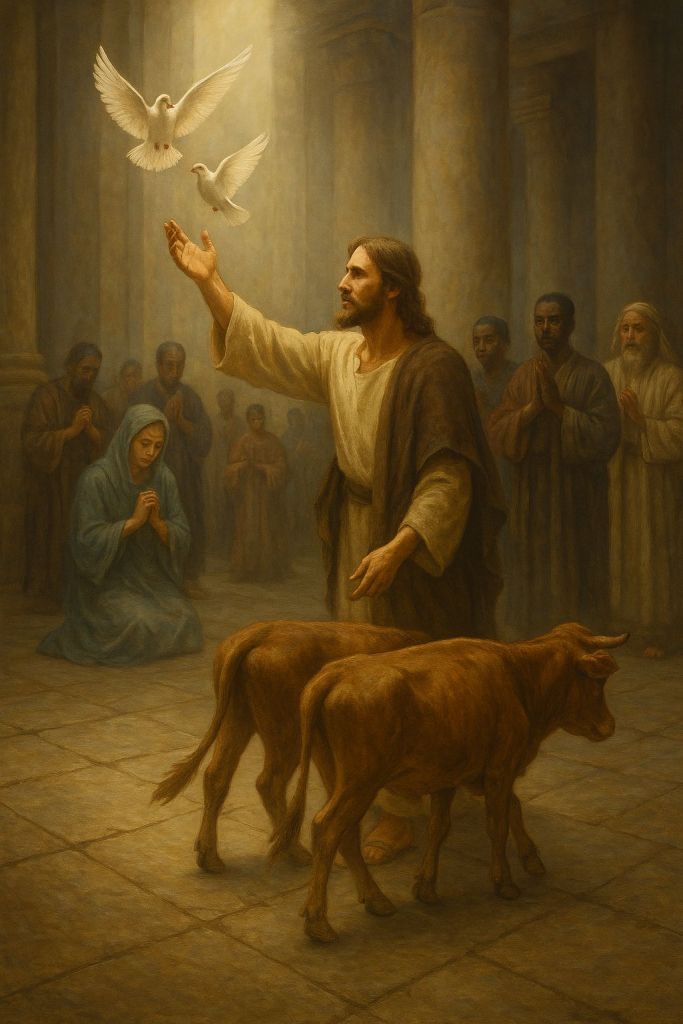
Even in righteous anger, Jesus was deliberate. His actions were considered, purposeful. And they were compassionate – He drove out the cattle, yes, but released the birds, sparing the vulnerable. He disrupted the systems that were exploiting the poor and the foreigner, especially in the very part of the temple – the Court of the Gentiles – meant to welcome those on the margins.
There are so many layers to this scene. It is rich with symbolism and challenge. It gives us permission to feel angry at situations, and it reminds us that God is for everyone.
As for me, when I see injustice, I find it hard to watch. But I also find it hard to confront. My voice trembles. My hands shake. My heart races. Speaking up comes at a personal emotional cost. But more and more, I realise I must imitate Christ, as hard and as uncomfortable as that might be.
Because there are people who don’t have a voice. Who don’t have the opportunity to speak up. And if I can, then I must. Not just out of duty, but as a privilege. To stand in solidarity. To protect the vulnerable. To clear space for worship, welcome, and justice – just like Jesus did in the temple.
So today, I’m asking myself where is Jesus encouraging me to speak up, even when it’s costly and uncomfortable?
May God give me the strength and the courage to imitate Jesus.
Yesterday’s reflection took me to a familiar verse—one I’d already chatted about last week in a conversation about prayer. Philippians 4:6-7:
“Do not be anxious about anything, but in every situation, by prayer and petition, with thanksgiving, present your requests to God. And the peace of God, which transcends all understanding, will guard your hearts and your minds in Christ Jesus.”
It’s comforting… and also challenging.
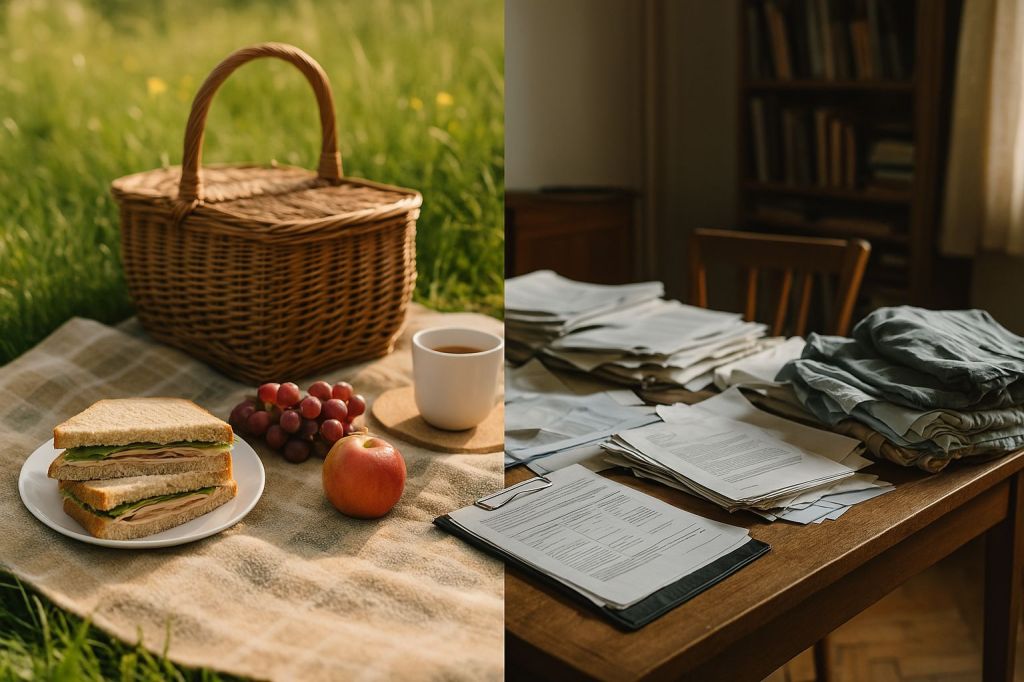
Because I do bring my requests to God. I lay them out like items from a picnic basket – my worries, my fears, my concerns for people I love. I try to be honest and open, to do exactly what this verse says.
And then? I pack it all back up again and carry it with me.
I wonder if anyone else does that.
It’s not that I don’t trust God. I do. Rationally, I believe God can handle far more than I can. But emotionally? Letting go feels unnatural. Especially when it comes to people I love; how can I just leave those concerns at God’s feet and walk away?
But maybe prayer isn’t about pretending our worries don’t exist. Maybe it’s more like clearing clutter from a dining table.
You know that moment when you’re trying to share a meal with someone, but the table is piled high with unopened post, paperwork, and laundry that still hasn’t found a home? There’s no space for connection until you move all that stuff aside.
That’s what prayer can be. Not just handing over our fears, but making room. Saying, “Here it is, Lord – all of it – and now I want to sit with You.”
We might still feel the weight of our concerns. But we’re no longer holding them alone. And in that space, peace, unexpected, inexplicable peace, can begin to grow.
It reminds me of something I have on a poster at home and at work. It says:
“I am God. Today I’ll be handling all your problems. Please remember that I don’t need your help. If the devil happens to deliver a situation to you that you can’t handle—do not attempt to resolve it! Kindly put it in the S-F-J-T-D box: the Something For Jesus To Do box. It will be addressed in My time, not yours. Once the matter has been placed in the box, do not hold onto it or attempt to remove it—holding on or removing it will delay the resolution of your problem! If it’s a situation that you think you are capable of handling, please consult Me in prayer to be sure it’s the proper resolution. Because I do not sleep, nor do I slumber, there’s no reason for you to lose any sleep. Rest, My child. If you need to contact Me, I’m only a prayer away.”
Maybe I need to read that more often.
So here’s my gentle challenge today—to myself and to you: what if we really did try to leave it with God? What if we let the clutter go, even just for today, and made room at the table?
In that space, God’s peace has a way of showing up—often quietly, always faithfully.






 The Reason for my Hope Blog