Lent 2026: Even me

I’m on retreat this weekend, a much-needed break from college deadlines. As ever with retreat houses, at least the ones I’ve been to, it feels like the middle of nowhere: a long winding track, surrounded by trees, and very little signal. It’s a strange relief to have an enforced break from technology. (Yes, I realise the irony of posting this. If I hold my phone in just the right position, I have just enough signal!)

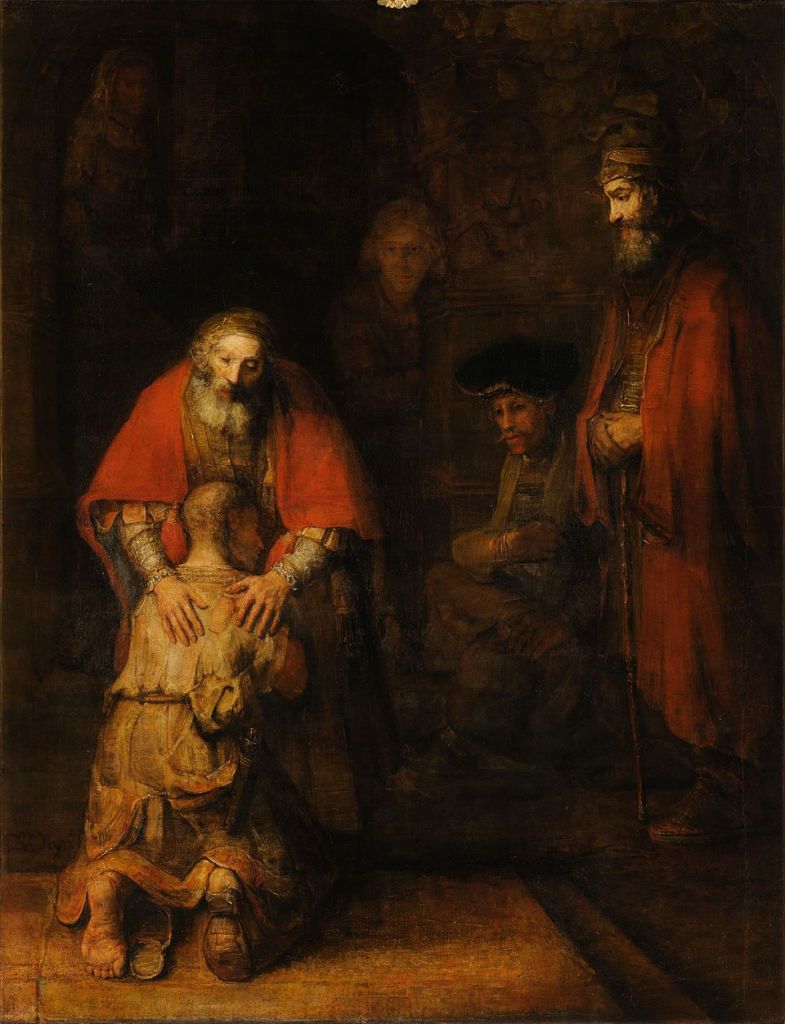
There are a number of paintings and pictures on the walls here, but one in particular is very significant for me. In the main social space hangs a copy of Rembrandt’s The Return of the Prodigal Son.

It’s significant because when I was at university and first decided to try the local church, the vicar happened to be reading a book by Henri Nouwen about this very painting, reflecting on Jesus’ parable through Rembrandt’s image.
Seeing it takes me straight back to those early days, when I was first exploring faith. Back then, the biggest question in my heart was simple, but heavy: Can God love even me?

This evening, sitting quietly in that room, my eyes kept returning to the painting.

There are several figures in the scene, but the lighting makes the father and the younger son the clear focal point. The son kneels with his head bowed, dressed in rags, one shoe missing. The father stands over him, wrapped in a red cloak, leaning forward with his hands resting gently on his son’s shoulders, drawing him close.

The parable tells the story of a younger son who behaves in a deeply shameful way, squanders everything he has been given, and eventually returns home in desperation. He doesn’t expect forgiveness. He hopes only that his father might let him work as a hired servant. Instead, his father restores him fully to the family. The older brother, out in the fields, reacts very differently.

Over the years I’ve heard many sermons on this parable. At times I’ve recognised the older brother in myself, when judgement or jealousy gets in the way of rejoicing and loving people well.
But if I’m completely honest, that old question still sometimes whispers in the background.

Can God love even me?

And tonight, sitting there and gazing at that picture of the father holding his undeserving son, the answer feels clear again.

Yes.

No matter what we do, or where we go, the Father welcomes us with open arms. He draws us close and offers grace we could never earn and never deserve.

So if, on your own journey of faith, you ever find yourself doubting or questioning, remember this:

You are loved.

And there is nothing you can do that will make God stop loving you.

The Return of the  Prodigal Son, Rembrandt

Lent 2026: Ordinary acts, extraordinary faith

Today I was learning about Dorothy Day, an extraordinary woman of faith of the 20th century. She was American, with a heart for social action all of her adult life. She converted to Roman Catholicism as an adult, and her literal interpretation of the bible fueled her social action. She took the words of the bible and put them into practice, with the commandment to ‘love neighbour’ forming a foundation for her actions.

I was struck by how her spirituality was woven into ordinary life – she lived out what she believed. Her motherhood shaped her ministry, and her everyday acts of care became profound expressions of faith. She started a soup kitchen, founded Houses of Hospitality, and welcomed everyone, anyone in need, showing how Christ can be seen in the face of every ‘sibling’ around our table, no matter their background or story.

I was especially moved because she carried a mother-heart, something I feel I also carry. The strength and love we carry in nurturing and caring for others can itself be a ministry. Her prayer, “Lord, what would you have me do?”, is simple yet costly. It’s a question that carries risk, remaining open to being the answer to her own prayers or the prayers of others. It’s a willingness to be inconvenienced for the sake of loving God and loving neighbour.

Faith doesn’t have to be heroic to be profound. Sometimes it lives in the ordinary ways we care, share, and show up—with our hearts, our hands, and our tables. Perhaps this is the essence of living spiritually: asking, “Lord, what would you have me do?”, and then being ready to answer, no matter the cost.

I may write more about Dorothy Day – I will be reading more of her work – but this evening I will leave you with a quote that stuck with me:

God meant things to be much easier than we have made them to be.

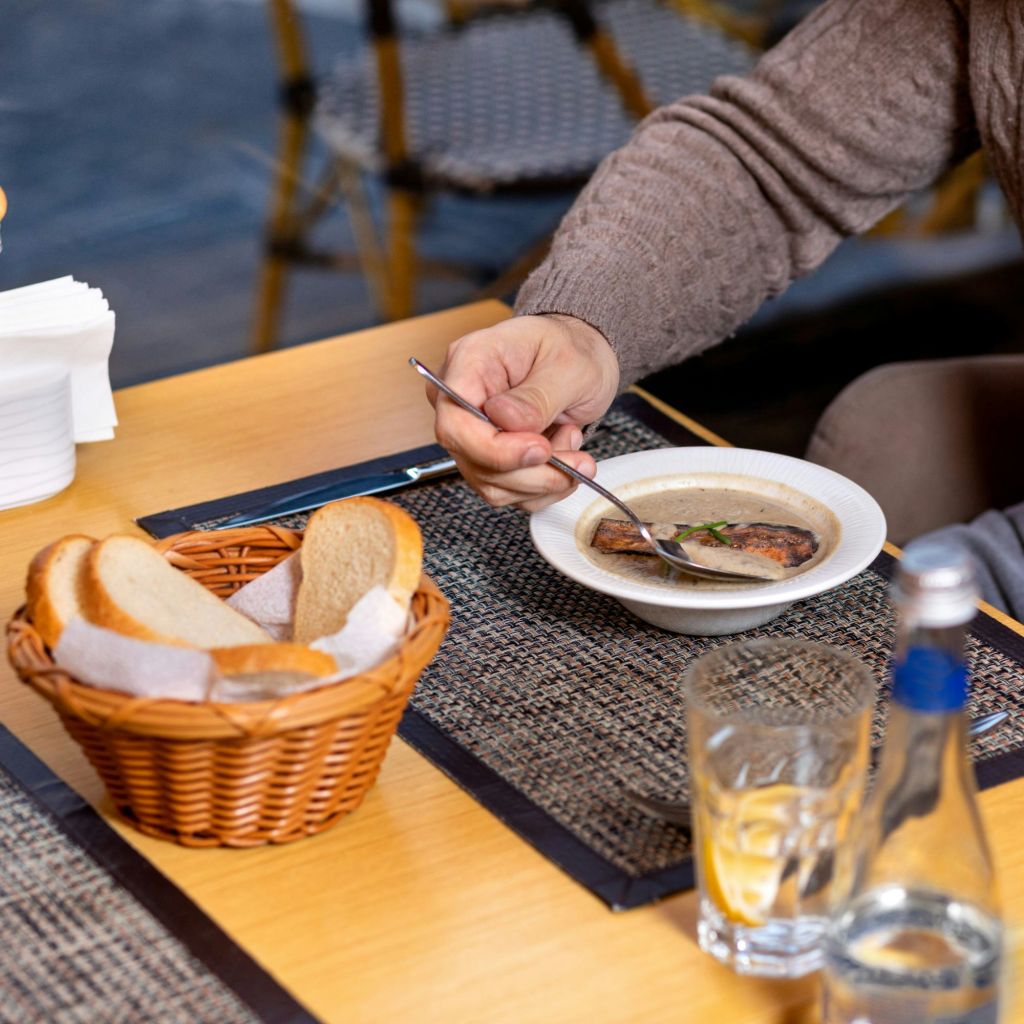
Thanks to Farhad Ibrahimzade @ferhadd for making this photo available on Unsplash 🎁 https://unsplash.com/photos/person-in-gray-sweater-holding-white-ceramic-bowl-with-soup-D5c9ZciQy_I

Lent 2026: When silence isn’t quiet enough

Does anyone else find it can get noisy in their head? Lots of voices demanding attention. Deadlines. Stress. Self-criticism. Doubt. Shame. To-do lists. Exhaustion. Plans. Regrets. Expectations. Just a small snapshot of my mind on an average day.

It can become cluttered and confusing, sometimes overwhelmingly so. And strangely, many of those voices tend to be negative. I can replay a mistake I made for weeks, yet a job well done might only linger for a few hours before quietly disappearing. Somehow criticism echoes, while encouragement whispers.

I’m beginning to notice that all this internal busyness makes listening to God quite difficult. At times I feel as though God could do with a megaphone just to get my attention.

That’s one of the reasons I like walking. It occupies part of my brain, requiring just enough focus to put one foot in front of the other and keep track of where I am going. (Although keeping track is occasionally optional. I have been known to get a little lost.)

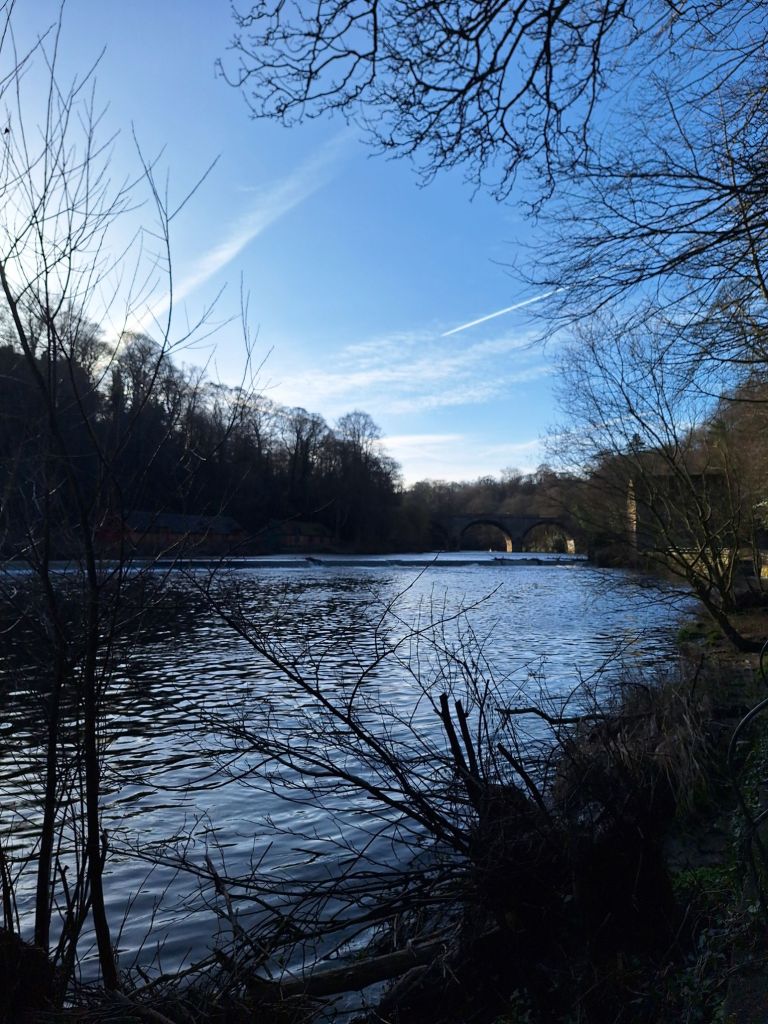
Near where I live there’s a river, interrupted by a couple of weirs that regulate the water level. They create a constant rushing sound, something like a muted waterfall. It’s exactly the right volume for me, loud enough to drown out the inner noise but gentle enough not to drive every thought away.

Sometimes it is possoble to meet with God in the silence, calm and still. But sometimes silence is simply too crowded. My thoughts fill it before God’s voice has room to settle.

The sound of the river changes that. Its steady rhythm seems to carry away some of the mental clutter, leaving space to notice that God was present all along. Perhaps hope sometimes begins not with God speaking louder, but with us finally able to listen.

Walking there has become a new favourite place to pray, especially now as the first signs of spring begin to appear along the banks. I’m learning that listening to God doesn’t always mean escaping distraction. Sometimes it means finding what helps us pay attention.

For me, at the moment, it’s water, movement, and the quiet companionship of a river flowing steadily onward. What about you? Where do you go to meet God? What helps you hear His voice beneath the noise?

Lent 2026: Attentive Hope

The posts over the last few days have been about hope. Perhaps that isn’t surprising in a blog called The Reason for my Hope! But they have explored a quiet kind of hope, one found in shared light, steady presence, and unexpected kindness.

A few years ago, I realised just how much I need hope. Without it, my emotions sink and the world begins to lose its colour. Everything feels heavier. Harder. Greyer. But when hope is present, I discover reserves of strength I didn’t know I had. Hope doesn’t remove difficulty, but it helps me persevere through it.

I first noticed this in January 2020, at the beginning of the Covid year when hope often felt in short supply. And yet, it was still there, if I looked for it.

It was there in sunshine that made daily walks more bearable. In exchanged smiles on socially distanced walks. In neighbours gathering for street parties, celebrating together while standing apart in their own gardens. Small moments, easily overlooked, quietly reminding us that isolation and despair did not have the final word.

In the years since, I have tried to cultivate a deliberate practice of gratitude. At first, I practically forced myself to reflect at the end of each day and name things I was thankful for. (Some days the list felt stubbornly small.)

But gradually something changed. I no longer had to search quite so hard. My attention shifted. I began noticing those sparks of light as they happened rather than only in hindsight.

Hope, it turns out, is often connected to what we learn to notice.

When life feels overwhelming, despair comes easily. Darkness draws the eye and holds it there. It can feel as though hope has disappeared entirely. The prophet Elijah knew something of that feeling.

After a dramatic victory over the prophets of Baal, when God answered Elijah’s prayer with unmistakable power, things should have ended in celebration. Instead, Elijah receives a death threat from Queen Jezebel and flees in fear. Exhausted and alone, he collapses in the wilderness, convinced everything has gone wrong. He is ready to give up.

God’s response is strikingly gentle. Elijah is given food, water, and rest before anything else. Only then is he sent to a mountain to wait for God’s presence.

A great wind tears across the mountainside, shattering rocks. But God is not in the wind. An earthquake follows. God is not in the earthquake.
Then fire. Still, God is not there. And finally comes a gentle whisper. Elijah recognises God in the quiet.

It is tempting to believe hope must arrive through dramatic change or unmistakable miracles. Something obvious. Something undeniable.
Sometimes God does act in ways that are impossible to miss. But more often, hope appears in smaller, quieter forms: the colours of a sunset, the first signs of spring, kindness offered without expectation, companionship given at just the right moment.

Unlike Elijah, I have not been sent to a mountain in the desert to listen for God’s voice. But I have learned that faith sometimes involves slowing down enough to notice where God is already present. Because signs of hope are rarely absent. More often, they are simply overlooked.

Hope grows when we learn to pay attention.

Thanks to Hasan Albari @hasanalbari for making this photo available on Unsplash 🎁 https://unsplash.com/photos/succulent-plant-on-ground-ETX60ClC7Bg

Lent 2026: Unexpected hope

I like it when a thought branches in my mind. One idea leads to another, sending roots and shoots in unexpected directions, inviting me to ponder and look again from a slightly different angle. That has been the case with what I’ve been calling candle theory.

First came Stubborn Hope; the choice to share light even when others seem determined to guard or hoard theirs. Then came Present Hope; the reminder that Christ is with us in the storm, even when the waves feel overwhelming. Today, I find myself thinking about hope appearing in unexpected places.

Last year I watched Star Wars: Skeleton Crew. The story follows a group of children who discover a wrecked spaceship and accidentally launch themselves into space. What follows is their attempt to find their way home to a hidden planet, kept secret to protect it from danger.

Towards the end of the series, one character, Fern, tries to persuade her mother to help save their world. She says:
Yeah, the galaxy’s scary and dangerous… everywhere we went, even the worst places, there were good people too.

I love that line. Stories often work this way. When everything seems lost, help appears from somewhere unexpected. A stranger offers shelter. The ‘enemy’ chooses kindness or mercy. Courage shows up where it was least anticipated. Yet this isn’t only true in fiction.

If we look only at headlines, it is easy to believe darkness has the final word. Violence, injustice and suffering dominate our attention. And if we are not careful, they begin to shape how we see the whole world.

But look closer. In the midst of crisis, people open their homes. Communities rally around strangers. Individuals choose compassion when indifference would be easier. Quiet goodness perseveres, often unnoticed.

Yesterday I reflected on Jesus being present with the disciples in the storm. Christ does not abandon us when fear rises. But the Gospel story does not leave us as passive passengers waiting for rescue.

We are invited to reflect that same light to one another. We light our candle from Jesus, and then carry that light into the lives around us. Sometimes we are the ones needing help. Sometimes we are the ones able to offer it. And often, unexpectedly, we discover others already shining in places we assumed were dark.

We do not need to calm the storm ourselves. Most of us cannot. But perhaps we can be the steady presence, the listening ear, the practical help, the small kindness that reminds someone they are not alone.

Perhaps hope grows when ordinary people like you and me choose to be the “good people” in difficult places. Unexpected hope does not arrive with fanfare. It appears quietly, in human hands, in shared light, in compassion offered when it would be easier to turn away.

And once you begin looking for it, you start to notice something remarkable. The darkness is never quite as complete as it first seemed.

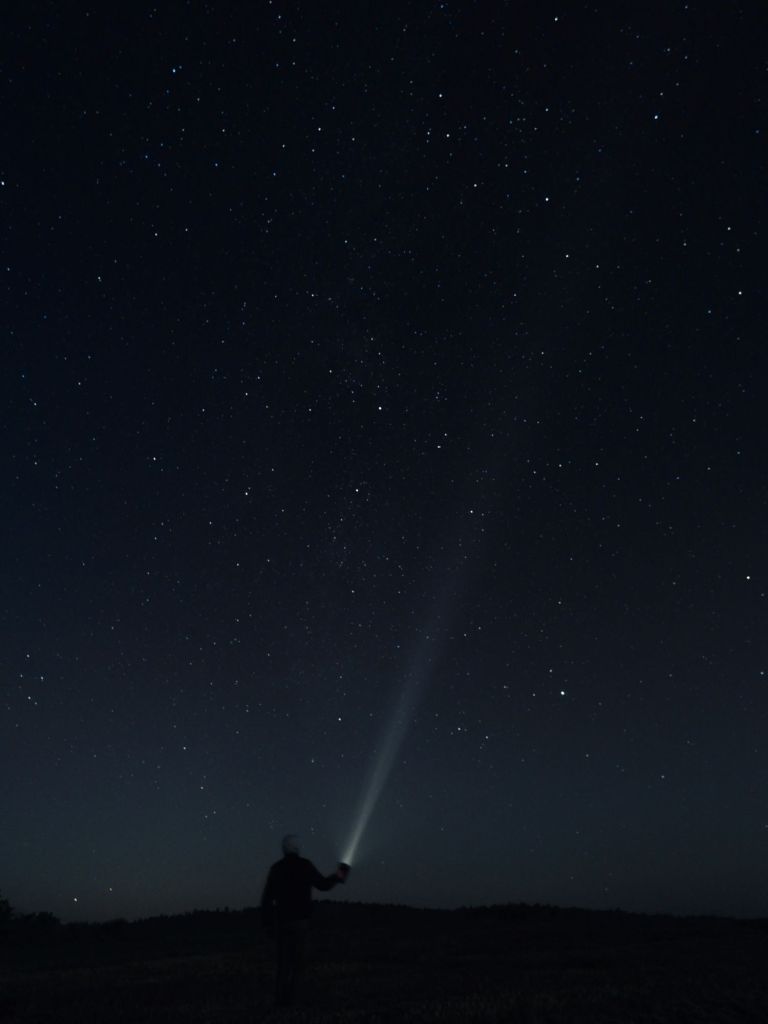
Thanks to Leon Rohrwild @leonrwld for making this photo available on Unsplash 🎁 https://unsplash.com/photos/silhouette-of-man-and-woman-standing-under-starry-night-Lf_k6hVizvs

Lent 2026: Present hope

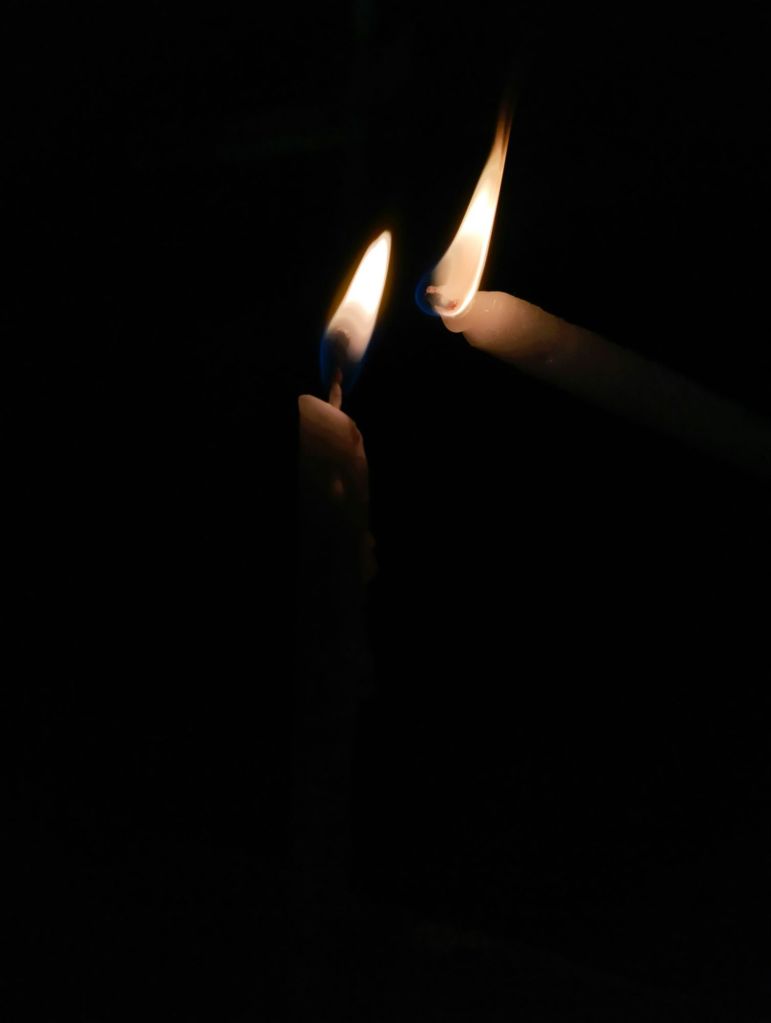
Yesterday I wrote about what I call candle theory; the idea that some things, when shared, do not leave us with less but instead increase what exists. Like light in a dark room. One candle lights another, and suddenly there is more light than before.

That reflection reminded me of a Bible passage I preached on just over a year ago: Mark 4:35–41, when Jesus and his disciples cross the Sea of Galilee. At least four of the disciples were experienced fishermen, people who had grown up on that lake and knew how quickly conditions could change. While they were sailing, a violent storm arose. Waves crashed into the boat, and panic set in. They knew exactly how dangerous this situation was.

And where was Jesus? Asleep at the stern.

Terrified, the disciples woke him, crying out, “Teacher, don’t you care if we drown?” Jesus wakes, speaks first to them, “Why are you afraid? Have you still no faith?” and then turns to the storm itself. “Be still.”

The wind dies. The waves settle. The disciples are left amazed and slightly afraid, asking one another, “Who is this? Even the wind and the waves obey him!”

When we look at the world today, storms are not hard to find. Some are caused by human choices: war, injustice, greed. Others come through the forces of nature itself. Hurricanes, floods, droughts and wildfires devastate communities and take lives. If Jesus could calm a storm then, why doesn’t he calm storms now?

I found myself becoming quite tangled in that question when preparing my sermon. I didn’t want anyone leaving church thinking that Jesus once intervened but no longer does. The question felt heavy and unresolved, a private wrestle rather than a public sermon. I felt I had a duty to the congregation to resolve it.

However, while praying over the passage, a quieter question seemed to surface instead: Why are you so focused on the storm?

Without ever setting foot in the boat, I had fallen into the same trap as the disciples. My attention was fixed entirely on the wind and the waves, on their power and their danger. I had forgotten to notice who was in the boat. In our own lives, the storms are often metaphorical rather than meteorological. Illness or bereavement. Job loss or financial pressure. Expectations that feel impossible to meet. Anxiety, fear, exhaustion.

There are many things that can fill our vision until fear becomes the loudest voice we hear. And like the disciples, we may find ourselves crying out, “Don’t you care?”

The striking thing about this passage is not simply that Jesus calms the storm. It is that he was present in it all along. The disciples were not abandoned. Jesus shared the same fragile boat, the same rising waves, the same danger. Before the storm was stilled, before fear subsided, Jesus was already there.

Faith does not promise a life without storms. Lent certainly does not pretend otherwise. Instead, it invites us to recognise where hope truly lies. Not in calm seas, but in presence.

Sometimes storms pass quickly. Sometimes they rage far longer than we would choose. But the Christian story tells us that we are never left to face them alone. Hope is not confidence that every storm will cease on command. Hope is trusting that, whatever comes, Jesus remains with us in the boat.

The wind may rage. The waves may rise. But we are not abandoned to them. Hope is present with us.

Thanks to Axel  Antas-Bergkvist @aabergkvist for making this photo available on Unsplash 🎁 https://unsplash.com/photos/ocean-waves-under-cloudy-sky-during-daytime-zrSzqDnfkQ8

Lent 2026: Stubborn Hope

It seems to me that there is a lot of darkness in the world. The headlines are full of violence and injustice, of powerful people taking advantage, of greed and cruelty. And in smaller, everyday ways too: unexpected illness, the breakdown of relationships, disappointments that arrive uninvited.

I won’t lie, there are days when hoping feels hard.

Despite having a public blog, I’m not someone who waves banners or shouts the loudest. I’m more likely to sit quietly alongside someone, offering support. To share skills or knowledge, and then step back so someone else can shine. I don’t mind the spotlight, but I don’t need to hold it.

I think of it as the candle effect. If I hold a candle in a dark room, it gives only a pinprick of light. Someone else may stand nearby with an unlit candle. I can guard my flame, afraid of losing it, or I can share it. And when another candle is lit, mine does not grow dim. Instead, the whole room becomes brighter. Not everyone seems convinced of this. Sometimes it feels as though light is scarce, something to be protected or hoarded.

During Lent, we are invited to look honestly at the darkness, both in the world and within ourselves. Christianity has never asked us to pretend that suffering or evil are illusions. The story we follow moves deliberately toward the cross, not away from it.

And yet, at the heart of our faith is this strange and persistent claim: the light shines in the darkness, and the darkness has not overcome it.

Recently, I found myself wondering whether small acts like this really matter. When power and influence are concentrated in the hands of a few, when darkness feels overwhelming, can quiet candle-sharing possibly make a difference?

In conversation, this thought emerged:
Hope is not the belief that the powerful will change. It’s the certainty that they are not the whole story.

The Christian story has always insisted this is true. Again and again, God works not through domination or spectacle, but through what appears small: a child in a borrowed stable, bread broken at an ordinary table, faithfulness that looks powerless beside empire.

When darkness dominates our attention, it can become all we see. Like someone hoarding candles in one corner of the room, the glare draws our eyes until we forget to look elsewhere. But the presence of great darkness does not mean there is no light. It simply means we must learn where to look.

Hope is not pretending everything is fine. Nor is it naively insisting that everything will work out. Hope is more stubborn than that. Hope is choosing, again and again, to live as people of the light. To share what we have been given. To trust that kindness multiplies, that encouragement spreads, that love offered freely reflects something of Jesus himself.

Perhaps hope begins not with changing the world all at once, but with lighting the candle in front of us and trusting that God is already at work in the growing light.

Lent 2026: There is love and there is fire in his eyes

There seems to be a theme to this week’s posts: music. I am always listening out for new songs to add to my ever-growing playlists. Some now stretch well beyond twelve hours, which means I often forget what is on them until something resurfaces unexpectedly when shuffle takes over!

One such song is Look to the Lamb. A fairly recent discovery for me, buried near the bottom of the playlist. The first time I heard it, a line in the chorus practically knocked me flat: There is love and there is fire in his eyes.

Just sit with that for a moment.

Despite everything I know about God, I think a small part of me still expects anger. Or perhaps worse, disappointment. Human experience quietly teaches us to expect judgement. We learn to brace ourselves for disapproval, to assume that when our flaws are fully seen, love might falter.

But what if, when we looked into his eyes, we saw love instead?

Hearing or singing this song still gives me chills. It makes me stop and wonder how often I assume God will behave as humans do. How often I expect criticism where God offers compassion, distance where God offers welcome, rejection where God offers belonging.

The line speaks not only of love, but of fire. And perhaps that matters just as much. Because fire can feel frightening. Fire consumes, it exposes. Fire refuses to stay comfortably contained. Yet throughout scripture, fire so often marks the presence of God. The burning bush that was not destroyed. The pillar of fire guiding God’s people through the wilderness. Tongues of flame resting gently at Pentecost.

This is not a safe or indifferent love. It is fierce. Passionate. Alive. A love that fights for us rather than against us. A love that burns away shame, fear, and every lie that tells us we are unwanted or beyond redemption. God is not tame, but he is for us. His fire does not exist to tear us down, but to refine, to protect, to lead.

John 3:16 reminds us that God so loved the world that he gave his only Son, that whoever believes in him should not perish but have eternal life.

There is love in his eyes. And there is fire too. And maybe, little by little, we learn to believe what we see there.

Love.

And fire.

Both turned towards us.

Lent 2026: The importance of community

I have heard a lot of teaching on how humans were made for relationship. Right back in Genesis, God creates Adam and says, “It is not good for man to be alone.” When no suitable companion is found among the animals, God creates Eve. From the very beginning, aloneness was not part of the design.

That truth has been driven home for me over the last couple of years. God has brought some really amazing people into my life. I now have a strong network of people I can call on when I am struggling which, let’s be honest, is not a rare occurrence. There are people who pray, people who listen, people who sit with me in silence, and people who gently challenge me when I need it.

If we were to wind the clock back ten years, I never would have imagined I would have this kind of community around me. I was more of a lone wolf. I helped others readily, but I rarely reached out for help myself. Somewhere along the way I had convinced myself that strength meant self sufficiency. In reality, it was fear. Fear of being known too well. Fear of being a burden. Fear of what might happen if I let people see the cracks.

Now, it feels less like I am walking a tightrope alone and more like there is a strong safety net beneath me. People who notice when I wobble. People who pray. People who listen. People who sometimes hold faith for me when mine feels fragile.

Last year I moved, leaving friends and family behind for a new adventure. It was exciting, but it was also tough. I had come to rely on those people, on their love and support, sometimes even on their faith when mine felt uncertain. Starting again risking being vulnerabe. To open up. To trust. New friendships have formed. New names have been added to my support network. And I hope, in some small way, I have become part of that network for others too.

It is hard to walk through this world. It is almost impossible to do it alone. But we were never meant to.

One of my favourite stories from Jesus’ ministry, recorded in the Gospel of Luke, tells of a woman who had been bleeding for twelve years. That meant she was considered unclean. She was cut off from normal community life. Isolated. On the outside. Doctors had been unable to heal her. Human solutions had run out.

Her only hope lay in reaching for Jesus. What I love about this story is that Jesus does not let her slip away unnoticed. He stops. He searches for her. And when she explains, he says, “Daughter, your faith has healed you.”

Daughter.

She is the only person Jesus addresses in that way. In a single word, he restores more than her body. He restores her identity. He restores her belonging. He draws her back into relationship. She is no longer an outcast reaching from the margins. She is family.

I think that is what community does at its best. It reminds us who we are. It calls us back from the edges. It gives us somewhere to stand when our legs are shaking.

If I have learned anything over the last decade, it is this: strength is not found in standing alone. It is found in letting yourself be known. In reaching out when every instinct says withdraw. In allowing others to carry hope for you when yours flickers low, and in being willing to do the same for them.

Letting people in can be frightening. Vulnerability always carries risk. But isolation carries a cost too. And in my experience, the gift of being known, supported and loved has been far greater than the fear.

I would not be where I am today without the people God has woven into my story. And I am deeply, deeply grateful.

Lent 2026: The wonder of love and the power of grace

I’ve often written about music and its place in my faith. The way harmonies and melodies can reach deep into my heart. But sometimes it isn’t the notes that break through. Sometimes it’s the words.

A few years ago, a friend introduced me to the song Vagabonds by Stuart Townend. I quickly fell in love with it and added it to a couple of playlists. I have a lot of songs on those playlists, though, so sometimes I can go a while without hearing it.

I was driving home recently when it came on. It’s a song about how all are welcome at the Lord’s table. The chorus goes like this:

Come to the feast, there is room at the table,
Come let us meet in this place.
With the King of all kindness who welcomes us in,
With the wonder of love and the power of grace.

It was that last phrase that stopped me. The wonder of love and the power of grace.

We are all welcomed at the table. No shame or guilt blocks our way. And it’s not because we have earned it, or have a right to be there. It’s because God’s love for us is so much greater than we can fully grasp, and because his grace means those things we have done wrong do not have the final word.

I don’t know who needs to hear this tonight, but please know the truth of these words:
Come to the feast, there is room at the table.
Come let us meet in this place.
With the King of all kindness who welcomes us in,
With the wonder of love and the power of grace.

Tonight, if you need reminding, there is room at the table. You are welcomed by the King of all kindness, held in the wonder of love and the power of grace.