Lent 2026: Holy chaos

Sometimes church is a tranquil place, where voices lift in tuneful praise. Sometimes church is a loud and chaotic place, where children feel free to express themselves in noise and movement.

Recently I went to church where exactly that happened. We had music, the grown-ups were singing, and the children… well, they were being exactly who God made them to be. There were crashes and hoots and general chaos, but we kept on singing and worshipping, with the odd smile directed at their young antics.

It reminded me of a different church a few years ago. It was café church. Less structured. Discussions around tables, tea, coffee and bacon butties. There was a family there whose youngest really didn’t want to sit still. Instead, they decided they wanted to make a domino run.

With Jenga bricks.

Under the communion table.

The vicar got down on the floor and joined in. Together they made a fantastic domino run. The bricks tumbled again and again as they tried to get it just right.

Later, the vicar said that while he was under the communion table, he was also praying. Praying that God would bless this act of worship. Because that young person was worshipping in their own way. It might have looked chaotic to the rest of us as the Jenga bricks fell for the umpteenth time, but that child was being exactly who God had made them to be.

What struck me at the time was how the vicar took what was happening and turned it towards God. I found myself doing the same thing. While the children around me created a little Holy Chaos, I smiled and turned it towards God.

Because worship doesn’t require perfect stillness or polished singing. Those things are lovely, but they aren’t essential.

Of course, there are times when noise makes things harder. The person at the back who struggles to hear, or the one who longs for a moment of quiet prayer. That matters too, and kindness means caring about one another in those moments.

But children are very good at reminding us of something important: God loves us to be ourselves. Messy, loud, joyful, chaotic.

God doesn’t wait for us to present ourselves perfectly before listening to us.

Perhaps worship isn’t about creating the perfect setting. Perhaps it’s about turning whatever is happening in front of us towards God.

And sometimes that worship sounds less like a cathedral choir, and more like holy chaos.

Thanks to Naveen Kumar @naveenkumar for making this photo available on Unsplash 🎁 https://unsplash.com/photos/brown-wooden-blocks-on-table-zo1jo5dWwwE

Lent 2026: Held in many ways

Today in the church calendar is Mothering Sunday. Traditionally, this was the day when servants were given time to return to their mother church, their home parish. Over time it has become something slightly different: a day to give thanks for those who nurture and care for us.

Perhaps that older meaning still has something to teach us. Mothering Sunday was never just about one person. It was about belonging, about returning to the place and the people who nurtured your faith and your life. Mothering Sunday today reminds us that throughout life we are often held in many ways – by parents, by friends, by mentors, by the quiet kindness of others.

However, it can be a complicated day. For some, it highlights distance from loved ones, or brings memories of those who are no longer here. For others there is pain in broken relationships, or the quiet heartbreak of wanting children but not being able to have them. For many, it’s a day with mixed emotions.

Growing up, I was taught that Mothering Sunday wasn’t just about mums. It was about all those people in our lives who mother us – those who nurture, guide and love us.

I remember hunting through the shops looking for cards that said Mothering Sunday rather than Mother’s Day. I remember church handing out posies to all the women in the congregation, a small token of gratitude for the countless ways they cared for others.

It wasn’t until much later that I realised how complex the day can be. In recent years my inbox has filled with “opt out of Mother’s Day emails”, giving people space if the day is too painful. Some stay away from church today. Some feel forgotten or overlooked.

But God sees. God remembers.

Psalm 34 tells us that “The Lord is close to the broken-hearted and saves those who are crushed in spirit.”

So today, if you are celebrating, Happy Mothering Sunday. Thank you for the love, patience and compassion you pour into the lives of others.

And if today is difficult, please know this:
God is with you.
You are seen.
You are known.
You are loved, exactly as you are.

And you are held in that love today.

Lent 2026: Holy Clumsiness

Yesterday I wrote about Panda Theory, the idea that we are loved without having to earn it. I gave the advice to “be more panda”, but today I want to explore that a little further.

Pandas are wonderfully clumsy creatures. They roll off platforms, fall out of trees, and, at least judging by the videos online, seem to get stuck in the most ridiculous situations. And yet they don’t seem particularly bothered by it. When a panda tumbles out of a tree, it doesn’t sit there questioning its life choices. It just climbs the next one. They are clumsy, but that doesn’t stop them living.

I wonder if we could learn something from that.

There’s a certain cultural instinct, especially here in England, to want to be proper. We like to know the rules. We like to do things correctly. And we definitely don’t like looking foolish. That probably isn’t uniquely English, but it does mean we often hesitate before doing something new in case we get it wrong.

Maybe “we” should really be “I”.

Even now, with plenty of experience of different styles of worship, I still feel a little hesitation when I walk into a new church or service. What are the unwritten rules? When do you stand? What if everyone else knows what they’re doing and I get it wrong?

This week in class our lecturer tried something that gently exposed this instinct. We were talking about joy in worship, particularly the idea of expressing joy through movement or dance. So she played a worship song and invited us to stand and move.
You might imagine the room erupting into joyful dancing. What actually happened was more of a polite shuffle. A bit of swaying on the spot. Nothing that might risk looking undignified. None of us danced with reckless abandon.

And it made me think about how often that instinct shows up in faith. There are things we don’t say, things we don’t do, and places we hesitate to go because we might get it wrong.

Take praying out loud, for example.
How many times have we stayed silent in a prayer meeting because we’re worried we might “pray wrong”? We worry our words won’t sound wise enough, spiritual enough, or polished enough. So instead of risking clumsy words, we say nothing at all.

But when we read the Bible, God doesn’t seem particularly concerned with polished prayers or perfect performance. I might go as far as to say the opposite is true…

Paul writes about hearing God say to him “My grace is sufficient for you, for my power is made perfect in weakness.” God’s power doesn’t wait for us to become graceful and perfect before it works through us. Quite often it shows up right in the middle of our awkwardness.

Maybe faith sometimes looks a bit like a panda climbing a tree. A bit wobbly, a bit undignified, occasionally ending in a tumble.

But the important thing isn’t climbing perfectly. It’s climbing anyway. Perhaps part of growing in faith is learning a kind of holy clumsiness. The courage to try something new. The freedom to get it wrong. The confidence that God’s grace is bigger than our awkwardness.

Pandas fall out of trees all the time. And yet somehow they keep climbing. Maybe that’s not a bad picture of the Christian life.

There were too many… an embarrassment of pandas being adorably clumsy

Lent 2026: Be more panda

Scrolling social media today I came across a cute picture labelled “Panda Theory.” It explained that pandas are clumsy, slow, and spend most of their day eating… and yet everyone loves them anyway.

Naturally, I assumed this must be a real psychological theory. So I looked it up.

It isn’t.

(There is a book called Panda Theory, but it didn’t seem to involve falling out of trees and rolling around adorably, so I lost interest fairly quickly.)

According to the post, Panda Theory says this: pandas move slowly, trip over themselves, and spend most of their time eating, yet everyone loves them anyway. They remind us that you don’t have to be fierce or perfect to matter. In a world obsessed with hustle and perfection, be the panda. You don’t have to earn your worth. You already have it. (Unknown origin so I can’t credit it)

Pandas appear on my social media feed quite a lot. My previous boss loved them and got me slightly hooked on watching videos of pandas being delightfully ridiculous. If you’ve never watched one, go find a video. I can almost guarantee it will make you smile.

Because once you start watching, you notice something. Pandas are wonderfully unconcerned with impressing anyone. They tumble out of trees. They bounce off things. They run around with buckets stuck on their heads. Sometimes they simply cling to a keeper’s leg like an oversized toddler. And the world absolutely adores them.

Pandas don’t really do anything to earn that love. They’re not especially useful in the way we often measure usefulness. They’re just… pandas. Existing. Living their slightly chaotic panda lives. Yet millions of people around the world delight in them.

Maybe part of the reason is that pandas simply live as they were created to live. They don’t strive to justify their existence. They just are. And that, strangely enough, brings people joy.

I’m not suggesting we start climbing trees and falling out of them. Humans don’t bounce quite like pandas do. And spending most of the day eating probably isn’t advisable for us either.

But maybe there is something we can learn from this so-called Panda Theory. We live in a world that constantly tells us our worth must be earned. Work harder. Achieve more. Be better. Be perfect.

Yet the Bible tells a very different story. Scripture reminds us that love begins with God, not with us. As it says in 1 John 4:19, “We love because he first loved us.”

Our worth doesn’t come from how productive or impressive we are. It comes from something far simpler: We are loved because we are God’s.

Loved before we achieved anything.
Loved before we proved anything.
Loved before we earned anything.

Grace, in other words, looks a little bit like Panda Theory. You don’t have to earn your worth. You already have it. So today…

Be a little more panda.

Thanks to Ruiqi Kong @sakamotomari for making this photo available on Unsplash 🎁 https://unsplash.com/photos/a-panda-bear-climbing-up-a-tree-branch-Z7M-vZIrj6c

Lent 2026: Your soul knows the steps

Today we were learning about a spirituality of joy. We listened to a video of Dr Barbara Holmes, a spiritual leader who died in 2024, talk about joy as an essential part of the spiritual life. One memorable quote from the talk was: “No matter their circumstances, we are called to joy.

It was surprisingly divisive among those of us watching. Some agreed with her take. Others felt it brushed suffering under the carpet. To me, it felt like a challenge.

Joy is not the same as happiness. Happiness is a surface-level emotion and can disappear the moment a storm rolls in. Joy runs deeper. It can survive the storm if we let it. (I know that’s a massive simplification, but bear with me here.)

That kind of deep joy can look suffering in the face and still survive the heartbreak. It can see someone in need and know you can’t fix everything, but still offer the one thing you can do. Maybe giving them your coat. Maybe making sure they have a hot meal.

It challenged me because, if I’m honest, it is much easier to complain. That’s been the problem all through history. Way back in Exodus, God rescues his people from Egypt and leads them towards the promised land. He provides food and water for them.

And yet… the Israelites complain.

“It would have been better to be slaves in Egypt. At least there we had plenty to eat.” (Paraphrasing Exodus 16.) Freedom, it turns out, can still grumble.

That same tendency is alive and well today. Negativity and cynicism creep in easily, and they have a way of draining the joy out of a room. Choosing joy in the face of trial and suffering can sometimes feel like swimming against the current. But perhaps that is exactly why it is a spiritual discipline.

Another story Dr Holmes shared has stayed with me. She spoke about a time when she a delayed operation meant that she was going to be wheelchair bound for a whole year. In the middle of that difficult season she sensed Jesus saying to her, “Dance with me.

Her response was immediate: “How? I can’t even get out of the chair.”

And the answer came back: “Don’t worry. Your soul knows the steps.

I love that image. Joy, perhaps, is learning to dance with God even when life feels restrictive. Even when circumstances pin us down. Even when grief or frustration or exhaustion are very real.

The body may feel stuck. The situation may not change. But the soul still knows the steps.

Maybe that’s because Christian joy isn’t something we create for ourselves. It isn’t about pretending everything is fine or forcing a smile through suffering – its not pretending to be happy.

Joy grows out of relationship. It grows out of walking with Jesus.

The one who says “dance with me” is the same one who walked through suffering, through the cross, and out the other side into resurrection life. Which means joy is not the denial of pain. It is the quiet confidence that pain will not have the final word.

And when life feels heavy or restrictive, perhaps the invitation is still the same.

Dance with me.

Because somewhere in the music of grace, our souls still remember the steps.

Thanks to Benjamin Wedemeyer @benjaminwedemeyer for making this photo available on Unsplash 🎁 https://unsplash.com/photos/silhouette-of-woman-during-sunset-V521_-OLizw

Lent 2026: Tending the flame

A long time ago in a galaxy far, far away…

Well, ten years ago in a town in the south of England.

Fresh from university, I was beginning to explore a possible call to ordained ministry. I spoke to the vicar of my childhood church, and she talked me through the process. She explained that it was long, and that multiple people would need to affirm the calling.
But that was necessary.

Ministry is hard. There may be times when a minister is tempted to doubt themselves and question whether they really are called. The discernment process gives them something to look back on. Something to remember. Something to reassure them when the road feels uncertain.

Her words have stayed with me, and looking back now I can appreciate the wisdom she was sharing.

Recently, a friend shared a post on social media. It spoke honestly about the pressures clergy face and how easy it is to burn out. It then listed eight ways clergy could build resilience.
Number six said: remember your call.

Sometimes, in the midst of busyness, when pressures and expectations pile up, it can be easy to forget why we do things. That is probably true in every vocation, but I suspect it is especially true for clergy.

There can be expectations to have answers to global, local, and personal crises. There is pressure to grow churches and support communities. In the middle of all that, it is easy to lose sight of why you began in the first place.

The advice in the post read:
“Remember the moment you first felt called. The people who believed in you. The reason you said yes in the first place.”

Those words echo something Paul wrote to Timothy in Second Epistle to Timothy: “Fan into flame the gift of God that is in you.

I love that image. Fire needs oxygen. Without space to breathe, a flame can be smothered. Yet even a struggling flame can be revived when it is gently fanned back into life.

Calling can feel like that sometimes. The pressures and stresses of ministry can threaten to smother it. But the flame can still be stirred again. Sometimes we simply need to remember.

Remember why we said yes.
Remember the people who encouraged us and believed in us.
Remember the God who called in the first place.

If that is you, in a vocation you once felt clearly called to but are now close to burning out, perhaps take a moment to remember why you said yes.

And if you know someone who carries a calling, whether in church leadership or elsewhere, perhaps ask them about it. Help them remember.

Because our journeys matter. God is present in them. And sometimes remembering the past gives us the courage to keep going.

Thanks to Prateek Gautam @pgauti for making this photo available on Unsplash 🎁 https://unsplash.com/photos/person-holding-lighted-oil-lamp-wX1GSlEHzuc

Lent 2026: Just for you

I love hearing people’s stories.

Memories from the past, chance encounters with people who changed everything, embarrassing childhood moments that have somehow become family legend. When people share things that matter to them, you start to see who they really are. It helps me understand them better. It means I know what might make them smile, what might hurt, and when they might need a bit of extra TLC.

This evening in the pub, the stories went a little deeper. We started talking about calling. How we first came to faith, and how we ended up where we are now.

There is a calling on every life. For some that might be parenthood, for others singleness. Some are called to offices and classrooms, some to hospitals or building sites, some to ministry. The shape of the calling is different, but the God who calls is the same.

What struck me tonight was just how different our stories were. One person spoke about the words of trusted friends who helped them recognise what God was doing. Another described moments when art and music stirred something deep inside. Someone else spoke about a series of small decisions which only later revealed a much bigger picture.

Each story was completely unique. And the interesting thing was the way one person heard God probably wouldn’t have worked for someone else.

Psalm 139 says, “You knit me together in my mother’s womb.” Jesus also tells us that even the hairs of our head are counted. God knows us intimately. He knows our personalities, our fears, our stubborn streaks(!), and the things that move our hearts. Perhaps it shouldn’t surprise us, then, that God speaks to each of us differently. The call comes in a way that we can hear.

In fact, this is how God has always called people. Moses encountered God in the burning bush while going about an ordinary day. Samuel heard his name in the quiet of the night. Lydia responded while listening to teaching beside a river. Paul’s call was far more dramatic, meeting Jesus in a blinding moment on the road to Damascus. Different people, different moments, different experiences, yet the same God, calling each one in a way they could recognise.

Some people might feel that they’ve never experienced anything like that. Perhaps life feels more like muddling through and doing the best you can. I understand that feeling too.

Sometimes God seems quiet. Sometimes the timing isn’t right yet. Sometimes we’re not sure if what we’re sensing really is God, so we ignore it. And sometimes, if we’re honest, we simply don’t want to hear it and head off in a different direction.

But the good news is that God knows us better than we know ourselves. He knows when we’re ready. He knows when the moment is right. And if we wander off course, he is remarkably patient in calling us back.

Perhaps that’s why hearing other people’s stories is so encouraging. It reminds us that there isn’t one uniform way of hearing God. One person may sense a quiet inner nudge to step into a church for the first time. Another might glimpse something of God in the beauty of Bach played beneath a cross.

Different paths. Same God.

So maybe the invitation is simple: ask someone about their story. Not to compare it with your own, but to marvel at the creativity of a God who knows each of us so well that he calls us in ways that are, quite wonderfully, just for us.

Thanks to Jessie Maxwell @jessiemaxwellphotography for making this photo available on Unsplash 🎁 https://unsplash.com/photos/wooden-signpost-with-multiple-arrows-in-forest-YX2vQT18G3A

Lent 2026: Abiding

There is something soothing about simple, repetitive actions: A gentle sway rocks a baby to sleep. Pacing back and forth can calm anxiety or steady frayed nerves. Slow, deep breathing can centre the mind.

Music can do the same thing. I have written about Taizé before, and often talk about music, but here I go again.

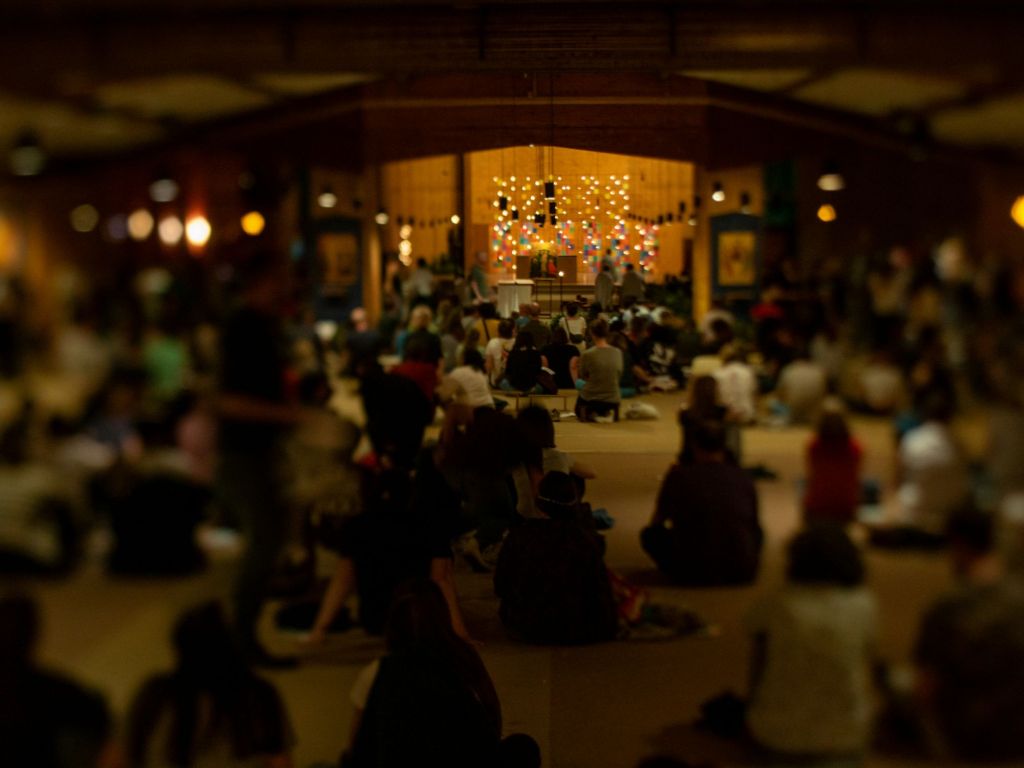
There is a simple beauty in a Taizé chant. The melody is uncomplicated, the words repeated again and again. Yet that repetition is not empty. Instead of rushing us on to the next verse or the next idea, it allows us to stay in one place and go deeper. Slowly, gently, the singer moves beyond simply saying the words and begins to abide within them.
It becomes a way of drawing closer to God.

I am not currently in Taizé, although my heart wishes it was. Last time I was there I bought a small book of chants, and there is one in particular that I return to as a personal prayer. It is a German chant based on a prayer by St Nicholas of Flüe:

Nimm alles von mir, was mich fernhält von dir.
Gib alles mir, was mich hinführt zu dir.
Lebendiger Gott, nimm mich mir
und gib mich ganz zu eigen dir.

Take everything from me that keeps me from you.
Give everything to me that brings me nearer to you.
Living God, take me away from myself
and give me completely to you.


It is a prayer of surrender.
A prayer of trust.
A prayer of offering.
And it is beautiful.

I keep coming back to this chant because, deep down, this is what I desire most. To let go of the distractions and hindrances that clutter my life, and to draw closer to God.

When I sing these words, it is humbling. Because I cannot do this on my own. Things get in the way. Sometimes it is simple distraction: television, books, the endless pull of everyday busyness. Sometimes it is something heavier: resentment, frustration, or the quiet weight of things that sit unresolved in the heart. Day to day life offers plenty of obstacles.

This chant turns that struggle into prayer. It becomes a gentle admission that I need help, and a longing for deeper relationship with God. It is both a comfort and a challenge. As the words are sung again and again, something in me softens. My heart opens a little more. And in that quiet repetition I begin to find a deep and steady peace.

I do not know what helps you connect with God. But if you have never tried it, perhaps listen to this Taizé chant and simply sit with it for a while. Let the prayer carry you.

Sometimes the simplest words can take us the deepest.

Gib mich ganz zu eigen dir
Thanks to Tomasz Kluz @tomcontour for making this photo available on Unsplash 🎁 https://unsplash.com/photos/people-meditate-together-inside-a-dimly-lit-hall-drCPdu2y3lY

Lent 2026: Practice makes perfect(ish)

This evening I was playing for the college badminton team. We won the match 9–0, mainly because the other team failed to show up… Not wanting to waste the time, we played some friendly matches among ourselves instead.

One thing that’s important to know about me is that I started playing badminton when I was six and carried on all the way through to university. That’s twelve years of playing multiple times a week, and I even took a coaching qualification along the way. Twelve years of practicing shots and technique, and learning the tactics of the sport.

It also means that even after a ten-year hiatus, I still know which end of the shuttle to hit!

In one of our games this evening, I won ten consecutive points on my serve (or immediately afterwards). That’s because I spent time practicing it, over and over again. We were always taught that the serve was the most important shot of the rally, so I invested time in getting it right.

I practiced the grip and the movement until they became second nature. I hit countless shuttles over the net to an empty court, aiming for the same spot on the other side. I practiced until I could probably do it in my sleep.

Now, it might be a bit predictable. If you face me in doubles, you’ll probably know what’s coming. I’ll start with a short serve towards the centre T. But that predictable serve is good enough that it won’t give you much of an advantage. You won’t be able to smash it straight back at me, and you’ll probably have to drop your racket to return it, which usually means the advantage swings to my team.

So what does this have to do with faith?

There are aspects of faith that are just as foundational. Spiritual disciplines like prayer, gratitude, and reading scripture grow and deepen as we move through life.

When we start out, we often have to concentrate quite hard on what we’re doing. In prayer, we might need a structure to follow or a list of things to pray for. We might need to deliberately set aside time to practice gratitude. We might use a set of questions to help us reflect on the passage of scripture we’ve just read.

But over time, something begins to shift. The rhythms become more familiar. The habits begin to settle in. We don’t have to concentrate quite so hard on how to do what we’re doing, and instead we find more fruit in simply doing it.

Maybe these disciplines are already second nature to you. If so, I wonder how many years of practice helped shape them.

Or maybe you’re still at the stage of practicing the movements and learning the structure. If that’s you, I encourage you to keep going.

Because just like that carefully practiced serve, the foundations we build over time quietly strengthen everything that follows.

Lent 2026: A prayer for wandering minds

The retreat I’m on this weekend is a structured retreat. There are brief talks/reflections gathered around the meals and worship, along with time set aside for silence and solitude, and fellowship.

This morning brought a wonderfully rich reflection. Across the weekend we are spending time in the letter of Jude, and the focus today was the second half of verse 20: “pray in the Holy Spirit.”
It’s a beautiful phrase, and one i recommend spending time reflecting on.

We were sent away with some simple but searching questions. What is our pattern of prayer? What is our context for prayer? And how do we persevere in prayer?

Prayer is something I develop by doing. Reading and listening will only get me so far, actually praying is most helpful. However I’m not someone who can easily pray continuously for a couple of hours without my mind wandering. Eventually I run out of words, thoughts, or emotions to hang my prayers on. My mind drifts off down side paths, and before I know it I’m thinking about something entirely unrelated.

So this morning I decided to try something different. On visits to Taizé, I’ve always loved how a single chant is repeated again and again. Instead of moving on to something new, the repetition allows the words to sink deeper. You dwell in one phrase rather than skimming across many.

I remembered a previous vicar once mentioning the Jesus Prayer. It is a simple prayer, repeated slowly, often in rhythm with breathing.

Breathing in:
Jesus Christ, Son of God.
Breathing out:
Have mercy on me, a sinner.

Just that. Over and over.

I didn’t need to worry about running out of words. I didn’t need to chase every wandering thought away. I simply held on to the phrase and returned to it whenever my mind drifted.

It’s a humbling prayer, acknowledging my need for God’s mercy. But perhaps that’s no bad thing. Prayer can sometimes become a list of requests, wrapped up with a few “pleases” and “thank yous”. This felt different. It was simply coming before God as I am, with nothing to hide behind.

And as I repeated the words, something else slowly settled in: I cannot redeem myself. I cannot grant mercy to myself. Those things belong to God alone.

But I was also reminded that God invites us to draw close. Mercy is not something God reluctantly dispenses. His arms are open.

Sitting in front of The Return of the Prodigal Son (see yesterday’s post) while breathing through that prayer, I felt as though I was quietly stepping into the scene myself. The son returning. The father waiting. Mercy already open.

If you find yourself with five spare minutes today, you might like to try the Jesus Prayer. No long list of words required. Just breath, and a simple turning of the heart.
Lord Jesus Christ, Son of God, have mercy on me, a sinner.

Thanks to Aaron Burden @aaronburden for making this photo available on Unsplash 🎁 https://unsplash.com/photos/silhouette-of-kneeling-man-lPCu8HnGU2E