It is said that if a person loses one sense, the others become sharper to make up for it. Someone who is blind will often be able to discern more through hearing and smell than someone who has all their senses. On a smaller scale, someone who is trying to concentrate on what they are seeing or reading might block their ears somehow, or someone who wants to concentrate on a taste or smell might close their eyes.
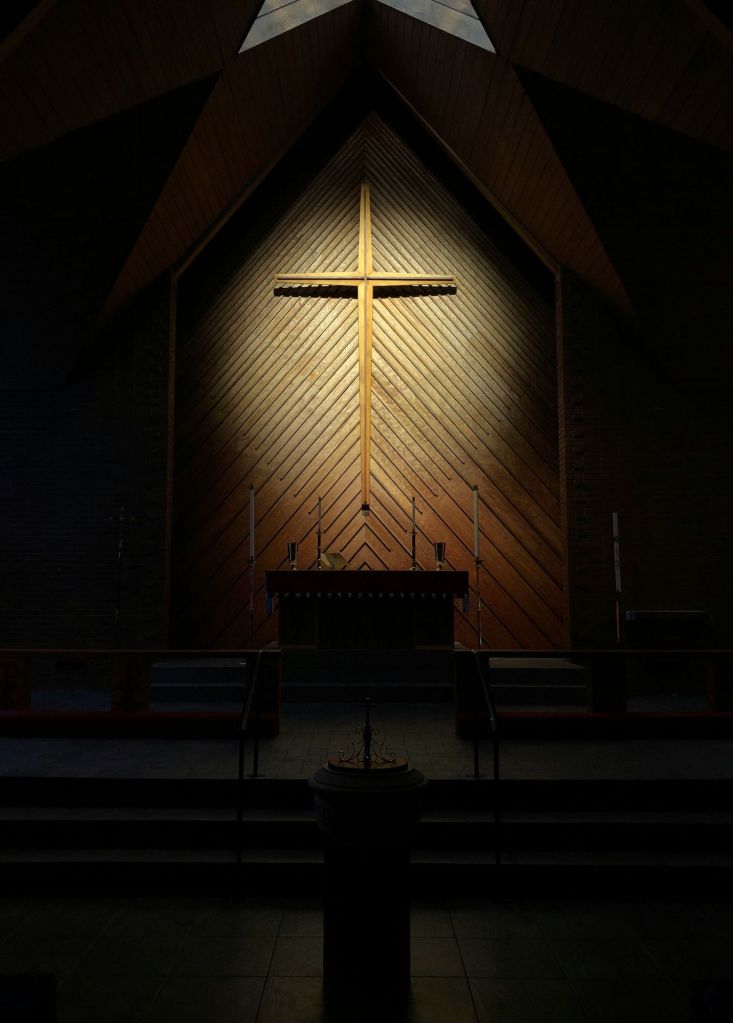
By ‘muting’ one sense, our other senses have the capacity to process more meaning they become more effective. A similar thing happens in a church in lent. Traditionally, the colours are more muted (although the purple often used today doesn’t always fall under the muted category…), flowers aren’t used to brighten the building, wordy ‘Gloria’s’ are replaced with simpler ‘Kyrie’s’ (Lord, have mercy) and ‘Alleluia’s’ used to decorate verbal worship are dropped until Easter. Without these elaborations, as wonderful and joyful as they are, the church enters a more sombre period with a sharper focus on relationship with God and what is getting in the way. It is often a time of prayer and fasting, of repentance, of turning around and returning to God.
By muting other area of our worship and other distractions within the building, we can more clearly focus on rebuilding an intimate relationship with God. Jesus has already made that possible through the events of Good Friday, we just need to empty our hands and grasp it.
Are there distractions around you that you need to mute temporarily? Are you holding things that are stopping you embracing the relationship God wants to have with you? What can you do to change that?
Becoming a helpful tradition for me in lent, 40 days of drawing closer to God through writing. As ever, some will be long and some will be snapshots, but all will be God focused in some way.
This year, Ash Wednesday, the first day of lent, has fallen on Valentine’s Day. Me, my housemates and some friends (all single) used it as an opportunity to celebrate a different kind of love.
Sometimes there can be a pressure from well meaning people, be that families, churches or friends, to find the right person and settle down (however that may look). But that is a societal pressure rather than a God pressure. In fact, in his letter to the Corinthians, Paul writes that it is good for the unmarried to stay single like him, but if they can’t exercise self control then they can marry! That’s almost the opposite of what society tells us today!
I think there is room in the world for couples and singles, for both to be happy and accepted. God created people to live together in community and created different types of love to describe those relationships.
So if today, you and your significant other did something special, that’s wonderful, and I hope you both felt truly loved and made memories together. And if you don’t have that significant other, I hope you know how loved you are by the people around you.
And remember, God loves you more than you could possibly imagine and there’s nothing you can do to forfeit that. Is there something you can do over the next 46 days to draw closer to God and discover more about how he feels about you?
It’s Easter Saturday. A day of stillness, and the beginning of the celebrations that Jesus is not dead. It is a time of joy. If you choose to believe…
Reflecting back on the Easter story, it strikes me how much choice plays a part. I don’t mean Jesus’ choice to endure the cross in order to save mankind, that still boggles the mind. I mean the choice to turn to Jesus or not.
Peter and Judas, both betray Jesus. Judas leads the soldiers to him, Peter denies knowing him and abandons him. Peter chooses to run towards Jesus, searching for mercy. Judas chooses to run away from Jesus, searching for an escape.
Two criminals are crucified along with Jesus, one on his right and one on his left. Both are rightly fully convicted of a crime. One chooses to mock Jesus, speaking perhaps out of fear of dying, or maybe anger at the circumstances. He mocks Jesus, challenging to save them all. The other points out that they deserve their fate, Jesus doesn’t. Then he asks Jesus to remember him. He chooses to accept instead of challenge.
All four of these men made bad choices. But two of them also made good choices – they chose Jesus. The other two… well, they didn’t choose Jesus.
We also have a choice. When we make a bad decision, we can let it consume us or try to run away from it. Or we can chooses Jesus, turn to him for mercy and grace. He won’t force us. He let’s us choose to run. But he will be waiting with open arms if we choose to return. Just look at the story of the prodigal son.
So whatever bad decisions you have made or will make, one good decision can wipe them out. Peter and the repentant criminal found that out. Follow their example. Choose Jesus.
I’ve spent quite a little if time today listening to and reflecting on the story of Jesus’ death. The only way I can describe it is brutal.
Jesus shares a meal with his closest friends. He shares bread and wine and some last advice, then he gets in his knees with a towell and washes their feet. In less than twelve hours they have fallen asleep when they should have kept watch, run away when danger looms, one has betrayed him for money, one has denied him out of fear. The friends he led and served all abandoned him. Brutal.
He gets tried by the high priests. People make up stories about him. They want him dead so hand him over to the Roman official asking for the death penalty. He is stripped, whipped and beaten. The lashes leave marks and draw blood. The beating leaves him bruised and weakened. His hands are tied he can’t defend himself. Brutal.
The soldiers humiliate him. They mock him with a purple ‘robe’ and a crown of thorns they push down on his head, drawing more blood. It runs into his eyes but with hands still bound there is nothing he can do but sit there and take the mockery. Brutal.
Back in front of the Roman official, the crowd who had cheered his arrival in Jerusalem turned on him. They choose to give freedom to a murdered instead of him. Rather, they call for him to be executed in the most painful and humiliating way on offer: crucifixion. The crowd who had loved him now call for his death. The Roman official, fearing a riot, washes his hands of Jesus’ fate and turns away. Jesus is alone and helpless again. Brutal.
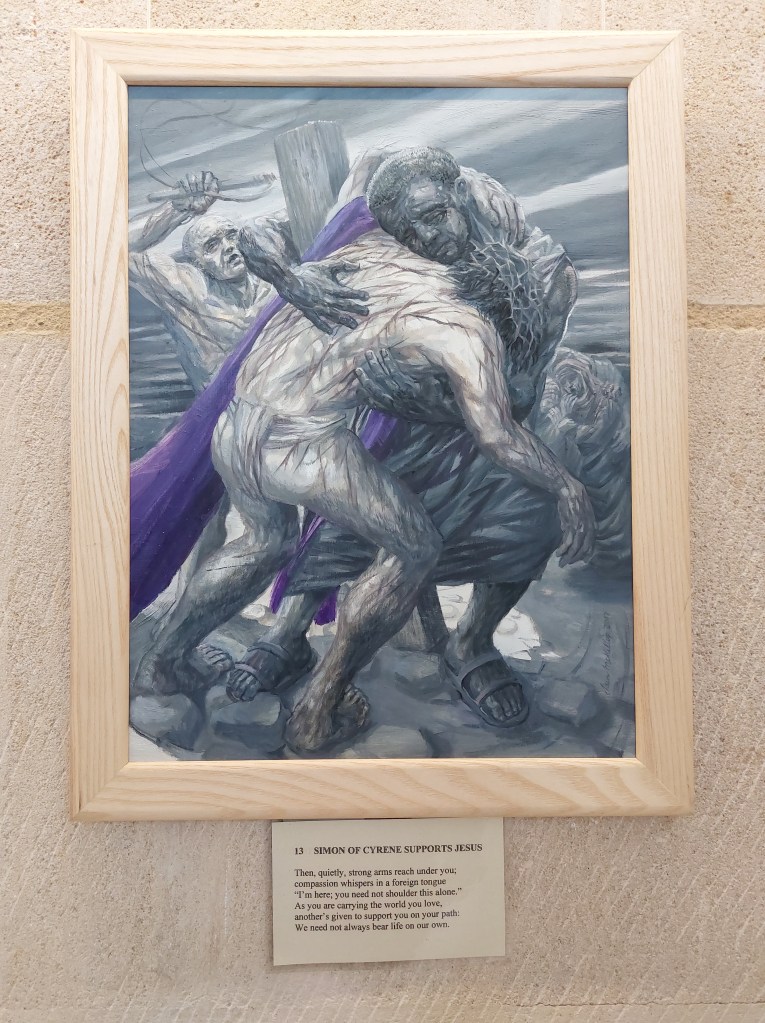
Jesus, already bruised, bloodied and weakened, is made to carry his cross through the streets to the hill of execution. Not just the cross bar, but the whole thing. The crowd jeers at him, they spit at him and the soldiers are all to ready with their floggers. He falls, collapsing under the weight of the cross and the flogging, but the crowd don’t help. Except one. Simon of Cyrene shares the burden, the insults, the whipping. He carries the cross with Jesus. And the insults continue and the beatings continue and Jesus still has to carry the cross up the hill. Brutal.
Once there, he is laid out on the cross. The soldiers get nails and a hammer. They line up his hands and his feet and drive the cruel iron nails through the delicate flesh. They pull his arms tight but bend his legs slightly so that when he is upright he has to choose whether his arms or his legs hold his weight as he slowly suffocates. Then he is hoisted skywards and displayed for all to see. The so-called Messiah, broken and humiliated, nailed to the cross. Brutal.
And let’s not forget Mary, his mother. She was there at the cross. Who knows how much more of this ordeal she saw. As a parent, she wants to protect her child. But she is helpless, watching on the sidelines as the future she has always known and possibly always feared comes true before her eyes, worse than she could ever have imagined. She sees his broken body. She sees the pain in his eyes, hears it in his voice. And she can do nothing but let it happen, nothing to stop her heart breaking. Brutal.
Already in a weakened state, Jesus doesn’t last long on the cross. When the soldiers break the legs of the others crucified, they declare Jesus already dead and don’t break his. But just to be sure, the pierce his side with a spear, doing further damage to his body. But mercifully, he is already dead. His suffering is finally over.
So when you hear the phrase, “Jesus died for you”, I urge you not to dismiss that as a nice thought, as a kind gesture. That is how much you are loved. Jesus chose to bear that for you. He endured pain in every imaginable way, he suffered, and he would do it again. For you.
You are important. You are loved. You have been saved. Because Jesus went through with this brutal death. For you.
Today we held a Maundy Meal at church. We heard the account of the last supper from John’s Gospel and we ate together. We didn’t have a full blown passover meal. Instead, we had some delicious home made soup with bread, cheese and fruit. We also didn’t wash anyones feet.
The gospel says how Jesus tied a towel around his waist and washed the feet of his disciples. This was something a servant or slave would have done – they all walked in sandals and so their feet would become dusty from the roads. So it is tradition on Maundy Thursday to emulate that in the service. It has always struck me as strange. Partly because our culture doesn’t normally do that so it seems an odd thing to do, and partly because I’m fairly sure that anyone who volunteered to have their feet washed had made sure they were clean before leaving the house and defeating the object of the exercise! There are plenty of churches that still do this symbolic act and plenty of people who find it helpful to participate in.
I remember one year at church we had a Maundy Supper where we washed the hands of the person next to us. I remember it very well because I was quite young, possibly 6, and the jug was quite heavy and I ended up dropping it and making some rolls very soggy! But culturally, washing hands makes more sense – a lot more people wash their hands before eating than wash their feet where I live.
But this evening, while we were eating, it was suggested we discuss what Jesus would be doing if he were around now. Different ideas were thrown around. Some focused on the hospitality side: having someone wash your feet was a sign of welcome and respect. Maybe Jesus would take our coats, or bring a chair so we could take off our shoes. Some focused on service: washing feet was a servants job, not a leaders. Maybe Jesus would serve the drinks, or maybe he would be washing the dishes.
Maybe what he would be doing doesn’t matter as much as why. Jesus gave an example for his disciples to follow, that they should go and do the same. That we should go and do the same. So we should wash everyone’s feet?
I don’t think it’s that simple. I don’t think it’s the action, I think it’s the heart. Jesus, their Lord and teacher, lowers himself in status to fulfil the role of a servant. He shows that he is willing to love and serve in a manner society would say is below him.
So what would Jesus do (wwjd) today? I don’t know. But I think it would be something that would make people sit up and listen, something that went against the status quo. Maybe he would offer to wash our feet. And I know he would send us away to do the same.
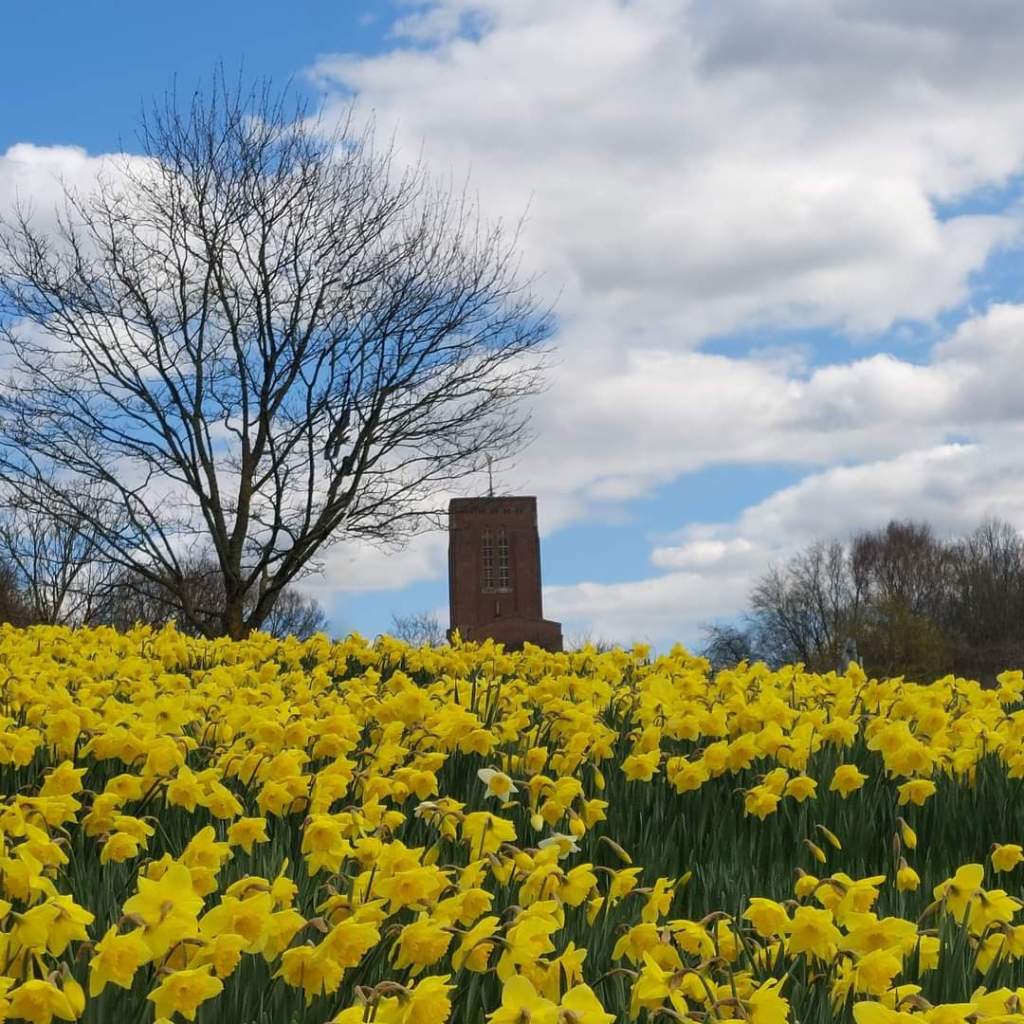
It’s a sign of spring, seeing the sea of yellow as the daffodils spring up. It’s a sign that the cold of winter is moving into the warmth of summer. It’s a sign of new life, a fresh start. Using limited gardening knowledge, daffodils are planted as bulbs in September and break forth between February and April (I think – I am many things, but not naturally a gardener!) That means a minimum of 5 months in the ground doing nothing.
Well, not really nothing. In those months they are developing roots. They are growing in an essential way so they can survive before blooming into beautiful yellow flowers. From what can appear to be dead and barren ground bursts forth vibrant new life.
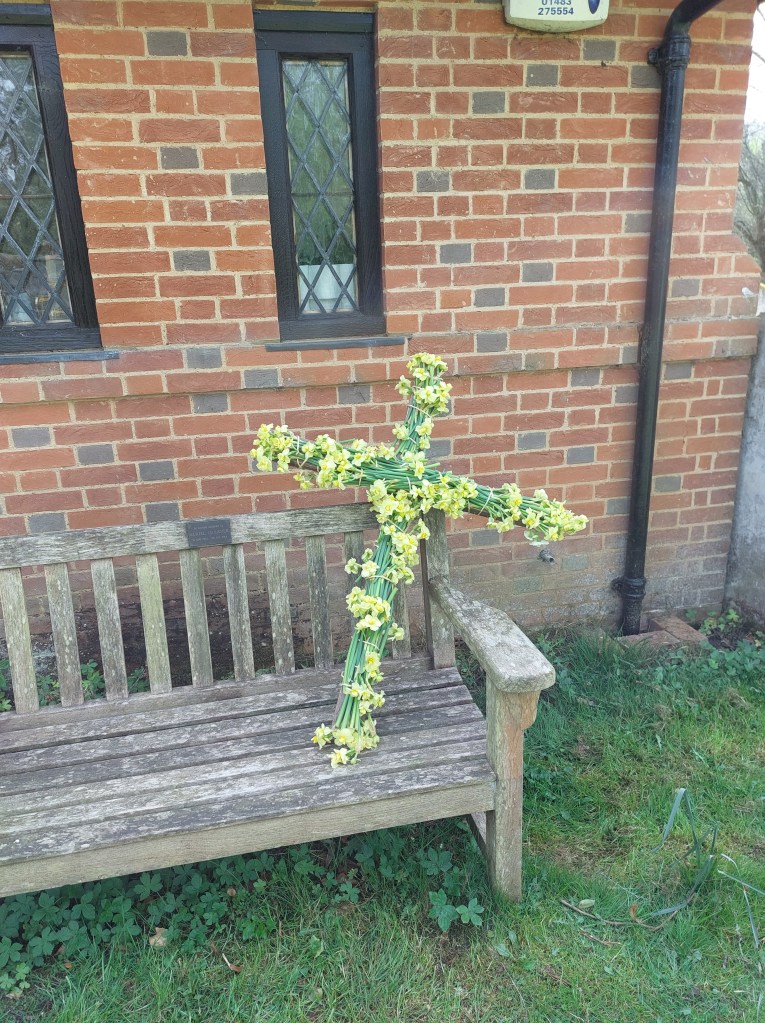
Growing up we used to have a wooden cross at church made from the Christmas tree. We’d strip it bare, chop it up and nail it together then put around it the different parts of the Easter story as we went through lent, things like the rooster, the silver coins and the crown of thorns. Then we would get to Easter Day and as we entered church we would be given a daffodil which we would go and tie onto the cross. We would transform the symbol of death into a thing of beauty, covering it in the flower most commonly associated with hope and new life.
So when I was talking today with a trusted friend and they said they could see daffodils, a sign if new life breaking forth, a sign of spring and an end to the winter, my mind jumped to the cross of hope.
When we are sitting in the dark and maybe it looks like we’re not doing much maybe what we are doing in is under the surface and in time it will bloom into something beautiful. Jesus died on the Friday and nothing happened, or at least nothing that could be seen. Except on Sunday Jesus was no longer in the tomb but instead was up and talking to the people he loved, so something must have been happening out of sight.
So when you see the daffodils, I hope they bring you hope. Hope in new life. Hope in changing seasons. Hope in transformation.
Today’s post follows a similar theme to yesterday, but using a different passage from the bible. I want to look at a small passage written by Paul to Timothy, a young leader of the early church that Paul had mentored and who, based on the contents of the letters, needed encouragement in his ministry.
The few verses I want to look at come from the second letter:
At my first defence, no one came to my support, but everyone deserted me. May it no be held against them. But the Lord stood at my side and gave me strength, so that through me the message might be fully proclaimed and all the Gentiles might hear it. And I was delivered from the lion’s mouth. The Lord will rescue me from every evil attack and will bring me safely to his heavenly kingdom. To him be glory for ever and ever. Amen
2 Timothy 4: 16-18
Paul was a Roman citizen and went around promoting Christianity, a religion with one God who wasn’t the Roman Emperor which got him into trouble with the Romans. And some of the Jews didn’t like what he was saying either – they didn’t believe Jesus was the Son of God. So Paul was imprisoned and threatened a number of times on his journeys, eventually being shipped back to Rome and being put under house arrest. I believe it is from here that Paul writes to Timothy to give encouragement.
Paul makes a point of showing how no one came to his defence, how they fled or stayed silent (which is similar to the disciples when Jesus was led away…) But then he says that God stood by him so that he could give his message. Paul isn’t asking for pity or sympathy, he’s not writing about his hardships for the sake of eliciting some response from Timothy, wither guilt at not helping or a determination to act for Paul’s defence. No, he is writing so his story, or rather God’s story can give encouragement. He uses his evidence of God’s presence and power to give strength to others who read about his story, primarily Timothy but now also us as we read it.
There is something comforting about someone who has been through the mill, who has endured so much – more than we probably know – and yet in the midst of it still firmly points to God’s goodness and blessing. And what’s more, he doesn’t say that God will fix it for him but rather that God will bring him safely to his heavenly kingdom. Paul has his eyes fixed firmly on God and his promise of eternal life. He holds firmly onto the belief and the hope that something better awaits.
So for us, moving forwards, when there are times we feel vulnerable and alone, we don’t have to search too hard to find God. We can trust that he is right there with us. And we can use our stories to encourage others and use others stories to encourage us.
God has been by my side every step of the way, even (especially?) when I didn’t realise it. He has given me strength and sustained me when I’ve felt broken and lost, and he is still with me now as continue to grow and explore. I hope my story, my belief can be some encouragement to you reading this. Because God is by your side too.
In a previous blog post I wrote about an art exhibition by Iain McKillop that’s currently on show at Guildford Cathedral. I wrote about a picture of Jesus in the garden of Gethsemane, about him being alone. Today I had some time to look at the pictures again. I was reminded of a part of the Good Friday story that can be glossed over.
After Jesus is sentenced to be crucified, he is paraded through the streets carrying his cross. He has been whipped and beaten and had a crown of thorns put in his head. He is tired and weak. On the journey to Golgotha, the hill where he is to be killed, it is thought (although not reported in any of the gospels) that Jesus falls more than once. Whether he does or not, three of the gospels report that a man was enlisted to help carry the cross behind Jesus.
This man was not family, nor was he a friend. In fact, he was a stranger who was plucked out if the crowd by the Romans. His name was Simon from Cyrene. He was forced to share the burden that Jesus carried. He shouldered the cross and had to endure the taunts of the crowd, just like Jesus. We never hear of Simon again. He is a support act here. But he is there. The disciples aren’t. Jesus’ family aren’t. Jesus’ supporters have either fled or turned on him. As I wrote last time, Jesus is so very alone at this point. Then Simon if Cyrene enters the frame.
I wonder how often we have felt so alone, so misunderstood, so isolated that we feel like we are carrying everything alone. I wonder how often we have been so tired and weak that we have stumbled and fallen to the point where we might not be able to get back up again and continue. I wonder if you have ever experienced a ‘Simon of Cyrene’ in your life, someone you have never met before and will never meet again but who does something to just help lighten the load for a short while, help you find the strength to keep going.
I would encourage you to remember, when you are down and not sure you can carry on, that Jesus got to that point too, and Jesus allowed a stranger to help him. Jesus didn’t have to carry his cross all on his own and neither do you.
I have lived in a number of different houses over the last 10 years. Some were student house shares, some were lodgings and some I was renting on my own. Some have been great, others were… difficult. But the one I am in now is a houseshare and I love it. When I tell people about it (because they know my track record with places to stay) I tell them it’s great. And then, every time, I go on to say, “we take it in turns to cook and then eat together in the evenings.”
It may seem something quite small but it’s unusual for me, something I haven’t particularly had in previous houses. There have been the odd night where I’ve had dinner with friends or invited them round to mine, but to actually know that most evenings I will sit with people to eat and catch up on their days and let off steam is something I treasure.
About a week ago at work we had a rare occasion where a number of us took a lunch break at the same time and we gathered in the small office kitchen and ate together. Conversation varied from serious to light-hearted. There was debate and there was laughter. And there was a sense of togetherness. There was an opportunity to get to know each other better and strengthen relationships between colleagues.
There is something about getting together over food that is special. In sharing a meal we open doors for easy conversation. In eating together and talking we get to know each other and build relationships, and the relationships strengthen, meals can become a time to relax and just enjoy time together on a daily basis.
That’s what Jesus did. He ate with people. He had dinner with Pharisees and sinners. He spent time with them, ate with them, talked to them. At the last supper, he was eating with his disciples. He had done this many times over their years together. They had followed him and learned from him, and they had eaten with him and each other. Their bonds had strengthened so they knew where they could turn. On Easter Day when Jesus had died and disappeared, they were gathered together. It wasn’t the best time for them. They may have been feeling scared or guilty or angry or all of these and more. But they knew they could stick together.
And when Jesus appears to the pair travelling on the Emmaus Road, he travels to their destination where he is invited in to eat with them. Which he does. There must be something special about eating together – that’s when they recognised Jesus. Again, on the beach while Peter is fishing with some of the other disciples, Jesus calls them in and eats breakfast on the beach with them.
Eating together is one of the greatest forms of welcome and belonging. It is something Jesus modelled with his disciples, building family so they would stay together. And it’s something I have come to appreciate, one of the greatest pleasures – to eat with people we love.
I have written before about shame. Its a topic I write about a lot because I think it is something a lot of people come up against and because shame is not godly. I have written about the need to bring things into the light so we don’t feel like we are hiding something. I have written about bringing whatever it may be to God, bringing it into the light and receiving God’s forgiveness.
But I was reading something the other day that opened my mind. There is another reason to bring mistakes and failures into the open. It could change the world.
If we acknowledge and own our own mistakes and accept how easy it is to slip, we may find it easier to understand and forgive others. Plus, when we don’t hide things in shame we have less reasons to beat ourselves up and can start to like ourselves a little more which shows in how we relate to others. So bringing things into the open could help build peaceful communities based on understanding and respect and minimise judgement.
But more than that, it gives people permission to make mistakes. There aren’t many places where it is safe to talk about mistakes and failures (and I mean those ones we’d rather keep hidden). Our very culture suggests they are reasons to be ashamed and hide. But what if we were to normalise talking about our mistakes and failures? Instead of trying to hide them and making the same mistake again, or letting our past define our future, we could realise that maybe we’re not alone. And if others have failed in that way, maybe they have advice. Or maybe we have advice others could use. Instead of failures being something to hush up, they would instead become an opportunity to learn and grow.
Let me briefly clarify, some failures are choices we make, and by permissioning failure I don’t mean allowing people to go around hurting other people or choosing to do things they know are wrong. What I mean is that if someone finds they have done something wrong, realises their choices have led to them stumbling, then they have permission to admit it. And I mean that on those occasions where people would rather not act for fear of getting it wrong we would give them permission to try without the fear of lasting shame hanging over them.
Where is my basis for this? There is a story of an encounter between Jesus and an adulterous woman. The crowd bring her to him and demand that he passes sentence on her. Jesus’ response is to tell them that the one who has never sinned may throw the first stone. One by one, the stones drop to the ground. Everyone has made mistakes. Everyone has fallen at some point. The crowd leaves, and Jesus and the woman are left alone.
“Where are your accusers? Didn’t any of them condemn you? Then neither do I condemn you. Go and sin no more.”
If the one who is perfect chooses to forgive when a failure is brought into the light, shouldn’t we also? And if we are honest and admit that we are not perfect and we fall, shouldn’t we have more compassion on the people we meet? If we stop expecting perfection in public, people won’t feel they have to hide their mistakes and maybe they will learn how to do better.
If we give ourselves and each other permission to fail we might just find that we live in a kinder world where people actually fail less often.







 The Reason for my Hope Blog