I’ve often written about music and its place in my faith. The way harmonies and melodies can reach deep into my heart. But sometimes it isn’t the notes that break through. Sometimes it’s the words.
A few years ago, a friend introduced me to the song Vagabonds by Stuart Townend. I quickly fell in love with it and added it to a couple of playlists. I have a lot of songs on those playlists, though, so sometimes I can go a while without hearing it.
I was driving home recently when it came on. It’s a song about how all are welcome at the Lord’s table. The chorus goes like this:
Come to the feast, there is room at the table, Come let us meet in this place. With the King of all kindness who welcomes us in, With the wonder of love and the power of grace.
It was that last phrase that stopped me. The wonder of love and the power of grace.
We are all welcomed at the table. No shame or guilt blocks our way. And it’s not because we have earned it, or have a right to be there. It’s because God’s love for us is so much greater than we can fully grasp, and because his grace means those things we have done wrong do not have the final word.
I don’t know who needs to hear this tonight, but please know the truth of these words: Come to the feast, there is room at the table. Come let us meet in this place. With the King of all kindness who welcomes us in, With the wonder of love and the power of grace.
Tonight, if you need reminding, there is room at the table. You are welcomed by the King of all kindness, held in the wonder of love and the power of grace.
It always interests me to see how different Christians worship. Some traditions are richly structured, with set liturgy and familiar rhythms. For many, that predictability is a gift. Others are more spacious, leaving room for spontaneity and silence. That freedom can be a gift too.
The Church has always found different languages for worship. None of them are wrong. They simply help different hearts find their way.
Today I was talking to someone about Eastern Orthodox worship. They had been to a service of Vespers, an evening office of prayer filled with incense and chanting, where the congregation stood throughout. They said, “It just kind of washes over you.”
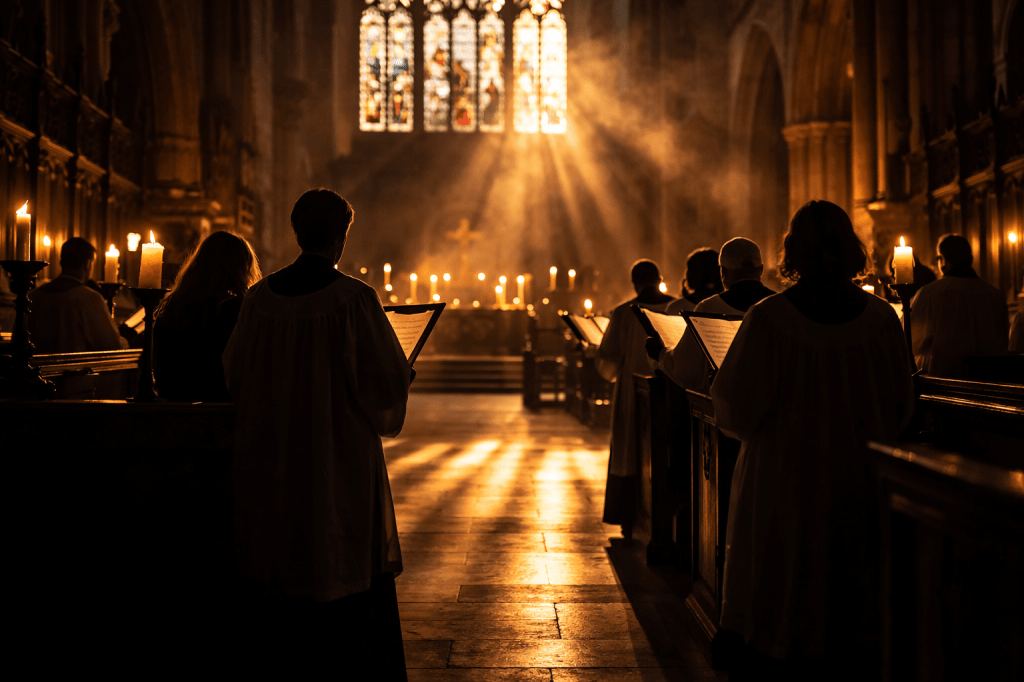
That phrase struck a chord. A couple of weeks ago, I was at choral evensong, another evening service shaped by prayer and song. Over the years it has been a comfort to me, though it often takes discipline to stay present. My mind is quite capable of drafting essays while the choir sings. On this particular evening, it was trying to do exactly that. Then the choir began God So Loved the World by John Stainer.
The harmonies are glorious, the melodies soaring. It is both calming and uplifting at the same time, which feels like a small miracle in itself. And the words, taken straight from Gospel of John 3.16, begin so simply: “God so loved the world…”
Just that first phrase was enough. It caught my wandering mind and drew it gently back. God so loved the world. Fully. Unconditionally. Loved.
The music didn’t demand anything from me. I didn’t have to analyse it or respond in any visible way. It simply surrounded me. It washed over me like a musical hug, warming my heart.
I find that music has a unique ability to draw me closer to God. It seems to bypass the overthinking part of my brain and go straight to the deeper places. I don’t need to articulate anything. I don’t need to construct careful prayers. It engages directly with my emotions and, somehow, elicits the most honest version of me.
Perhaps it helps that I am musically trained. But it is more than familiarity. It is what music does to my heart. Music is the place where my faith breathes most naturally.
And I wonder if that is part of what my friend experienced at Vespers too. Worship sometimes works not because we strive harder, but because we stop striving altogether. It becomes something to receive rather than achieve. Something to enter with open hands instead of clenched effort.
There are many ways to worship, and each offers its own doorway. But I know this: music brings me closer to God than any other style of worship.
When I woke this morning, the sun was streaming through my window. It feels as though it has been hiding for most of this year. Rain. Cold wind. Grey skies that never quite lift. So to open my eyes to blue was an uplifting start to the day.
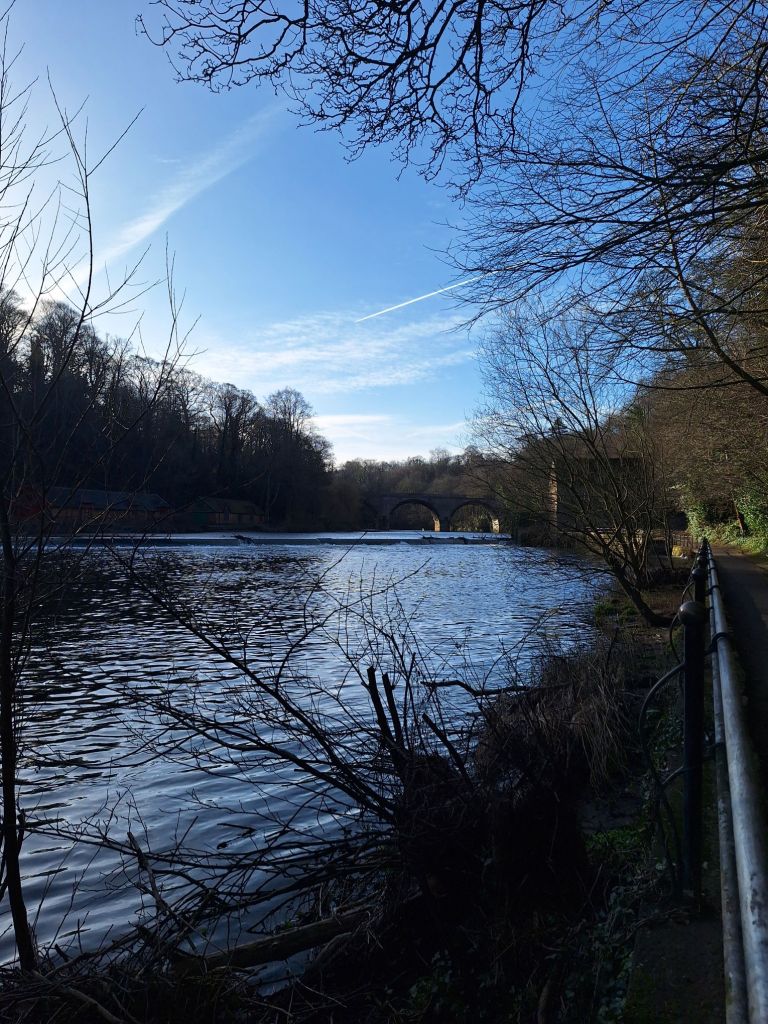
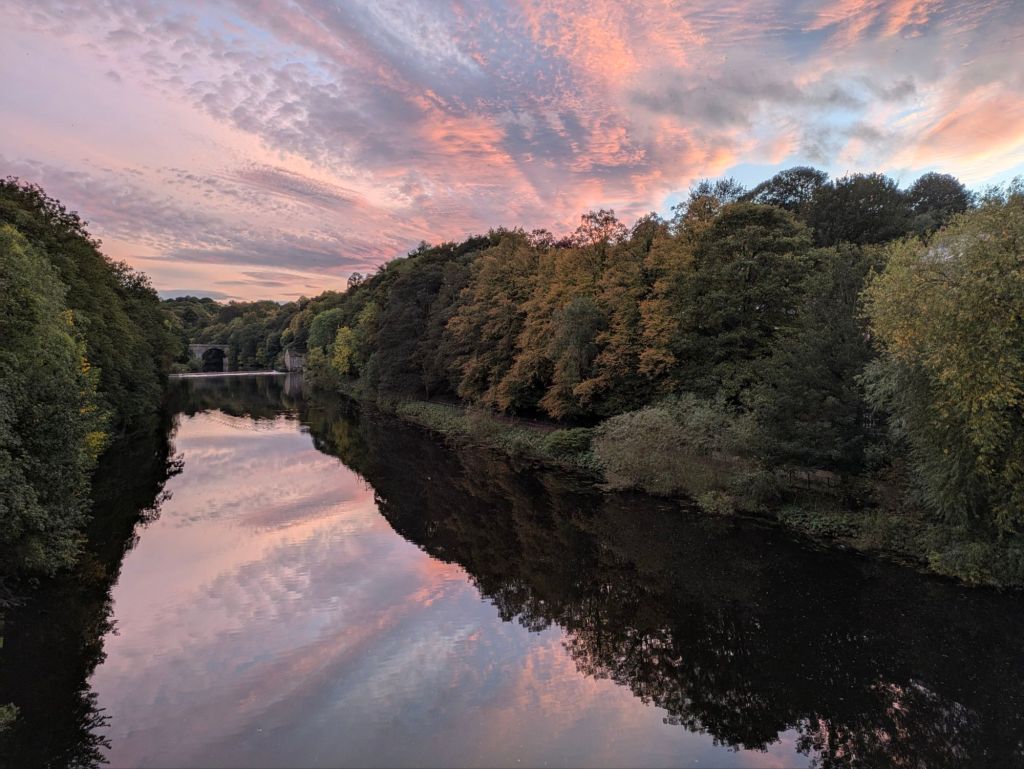
I walked to college for morning prayer, taking time to hear the birds. On the way back I ambled along the river, watching light catch on trees and bridges. There was no rush. I wanted to savour the tranquillity.
Back home, it became a solitary kind of day. Books open. Notes taken. A couple of deadlines quietly looming. I got my head down and worked. It felt good to have the time and space to do exactly that.
There was a time when I loved silence. Found it life-giving. Restoring. Then there was a season when I dreaded it. Silence amplified everything I was trying not to hear. It felt suffocating. Disconcerting. Like being left alone with thoughts that would not behave.
Today was not that kind of silence. Today was a good silence. It did not feel threatening or lonely. It felt necessary. Like a gift I hadn’t realised I needed. Even with deadlines hovering at the edge of my mind, there was peace in the quiet. A steadiness. A sense that I did not need to fill every moment with noise or productivity.
We all need days like these. Even Jesus did.
More than once in the Gospels, he withdrew to a quiet place to be alone. Before decisions. After crowds. In the midst of relentless need. Solitude was not weakness. It was sustenance. I suspect it was part of what anchored and sustained his ministry.
In a society that urges us to be visible, busy, always available, always striving, there is something quietly rebellious about stepping aside. About enjoying birdsong. About walking slowly by a river.
If Jesus needed stillness, then so do we. Perhaps silence is not something to fear or fill, but a gift. Not every day will feel like this. I know that. But today did.
Just a short post today. I’m sure there’s much more Catan could open my eyes to, but just one more for this little series.
This time, I’m moving away from strategy. I’ve said before that Catan is a game of luck made to look like a game of strategy. That’s a little unfair, of course. Strategy has its place. But if the dice don’t roll the right numbers, even the best planning goes out the window.
The thing is, the dice don’t always realise which numbers they’re supposed to roll. In my last game, I’m fairly sure 5 and 3 appeared far more often than 6 and 8. I’ll leave you to work out the probabilities.
Here’s the thing: when your numbers aren’t rolled, you sit there watching the dice land.
Three. Five. Nine.
Someone else collects. Roads extend. Settlements grow. You glance at your cards and realise you’re still holding the same hand you had two rounds ago, and there’s still no wood in the game.
At one point someone asks, “Does anyone have wood to trade?” “Roll a 6 and I will!” We laugh or roll our eyes. But there is truth in it. The willingness is there. The ability is not.
You aren’t doing anything wrong. You just aren’t receiving anything new. There’s a particular frustration in that kind of waiting. You’re ready. If an 8 rolled, you could build. If a 6 appeared, the resource you need might finally be up for trade. But readiness does not create results.
You cannot force a roll.
You can only play on, taking your turn and watching others get ahead.
I wonder how much of the spiritual life feels like that. We prepare. We pray. We try to live faithfully. And sometimes growth feels tangible and visible. Other times it feels as though everyone else is building while we sit with the same small handful of resources. I know there have been seasons of my life that felt like that, like I was stuck in limbo while others moved forward.
Scripture is surprisingly honest about waiting. Abraham waited. Hannah waited. The disciples waited between promise and Pentecost. Even resurrection had a silent Saturday. All of them living between what had been promised and what had not yet arrived.
Waiting is not absence. It is a space where trust grows roots instead of branches. You can’t always see it, but by choosing to stay present, to keep praying, something steadier is being formed.
In Catan, the wise player doesn’t storm off when the dice misbehave. They stay attentive. They watch the board. They keep track of what others are building. They prepare for when the number finally does roll.
Perhaps faith is something like that. Not frantic striving. Not giving up. Just staying at the table.
Sometimes the number comes quickly. Sometimes it doesn’t. But the story isn’t over just because your turn was quiet.
If you read yesterday’s post, you’ll know Catan has become a popular game with some of my family. It’s also turning out to be a goldmine for theological thinking, so here’s a second reflection inspired by the board game.
Our games of Catan have a particular rhythm. Not the dice. The conversation. The board fills with roads and settlements, but the real activity happens in the air above it.
“Does anyone have sheep?” “What are you offering?” “I can trade wheat.” “Two wheat?” “For one sheep? No way!” “…fine, one wheat”
There’s a cautious generosity to it all. Trades are rarely pure kindness and rarely pure self-interest. Both players are hoping to move forward. Sometimes several people want the deal and there’s a friendly rivalry as players bid for the resource. Sometimes nobody can help and the question just hangs there for a moment before the turn continues.
Occasionally someone gets left out without anyone intending to exclude them (see yesterday’s post). Mostly, though, the game moves because people keep talking.
You can try to play silently, building only from what the dice give you, but I’ll stick my neck out and say that never works. You stall. The board grows around you. The game carries on elsewhere.
Catan, for all its strategy, probability and luck, runs on conversation. And I think many parts of life do too. We often imagine independence as strength, as though maturity means needing less from others. It certainly felt like that was what society tried to teach me growing up. Yet a surprising amount of human flourishing begins with a sentence that feels slightly uncomfortable to say out loud:
Does anyone have…?
Not a demand. Not even a plan. Just an admission that we cannot progress alone.
It makes me think of Bartimaeus, sitting beside the road while the crowd moved past him. He didn’t wait to be noticed. He called out. Loudly enough to irritate people. Loudly enough that others tried to quiet him. Yet he persisted, because he needed help and believed Jesus could give it. Conversation replaced distance. Attention replaced assumption. His healing began not with sight restored but with a request voiced.
There’s vulnerability in that question. You are telling the table what you lack. You are giving others the ability to refuse you. You are trusting that someone might want your progress as well as their own.
Sometimes the answer is yes. Sometimes it is no. But the asking itself changes the shape of the game.
The communities I’ve seen work best aren’t the ones where everyone agrees or everyone gives everything away. They’re the ones where people keep speaking, keep asking, keep responding. Mutual benefit becomes the normal pattern of life rather than a special act of generosity.
Jesus didn’t only teach people what to believe; he formed a group that needed each other. Meals, requests, shared resources, ordinary interactions. The early church is described as a place where people shared what they had so that no one was in need. They talked, they shared, and that made space for mutual flourishing.
Catan is a game, and everyone is trying to win. But if even a game with only one winner teaches us to communicate and ask for help, how much more important is that in the real world? Perhaps love often looks less like heroic sacrifice and more like ongoing conversation.
A quiet table rarely becomes a community. But a table where people keep asking and answering just might.
So I’m learning not to be embarrassed by small requests, and not to overlook them in others. Sometimes belonging begins with nothing more profound than this:
Do you like games? I do, especially board games that pretend to reward strategy while quietly smuggling in chaos.
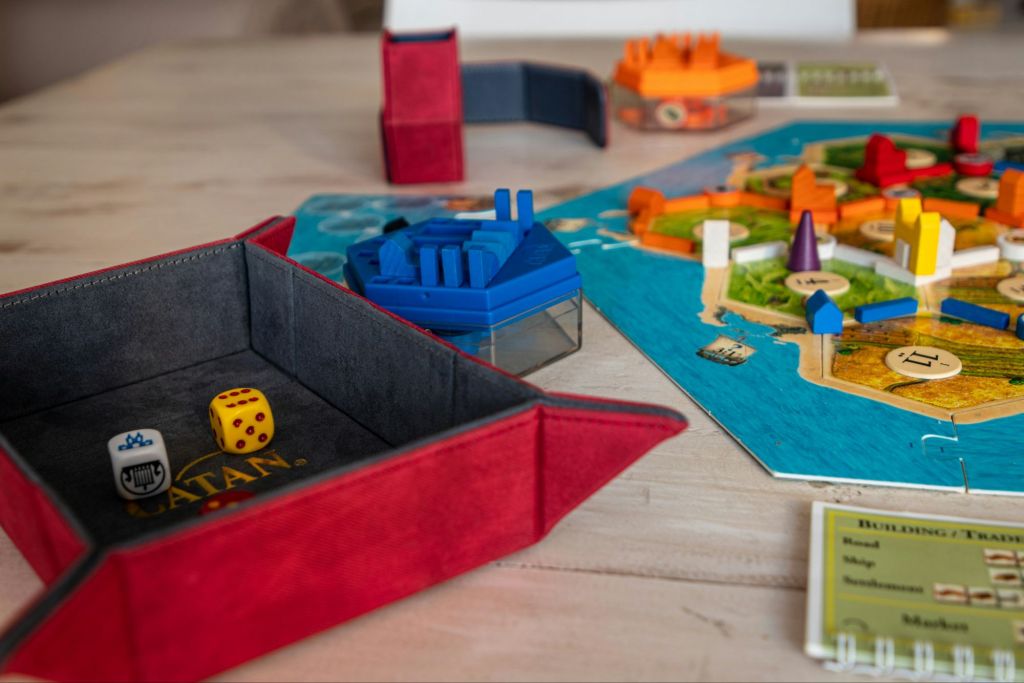
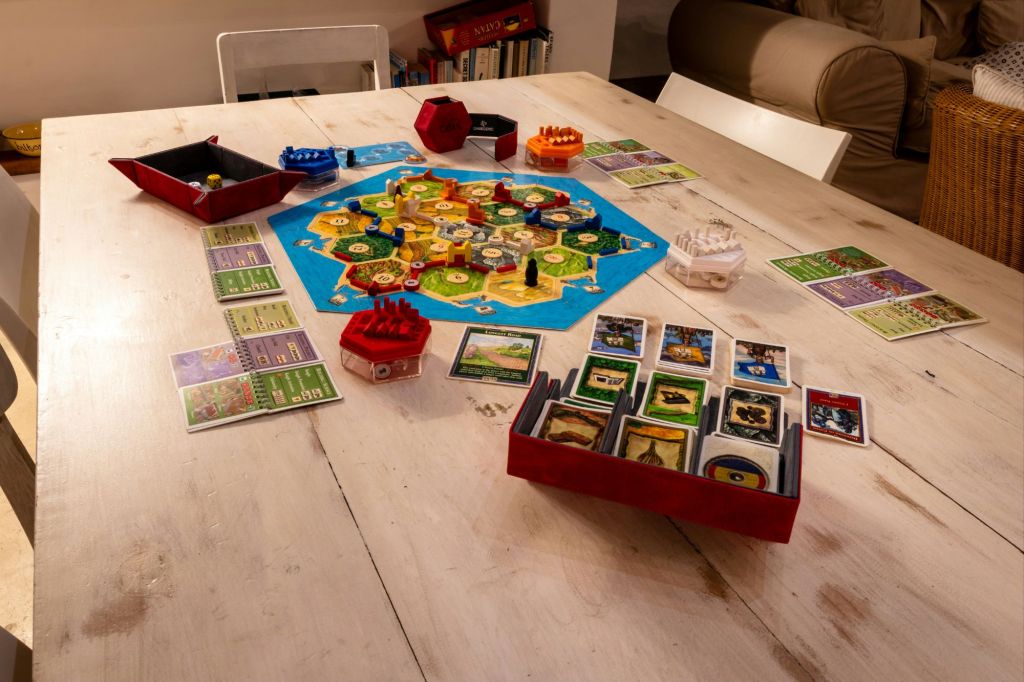
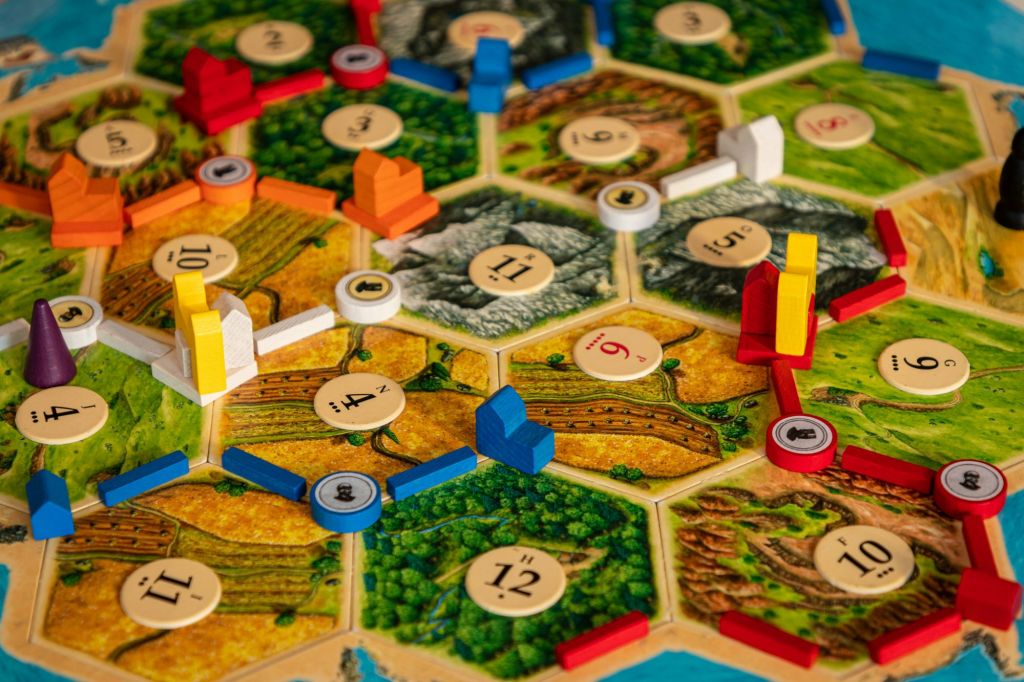
Recently our family favourite has been Catan. The idea is simple: the board is made of different resources, wood, wheat, sheep, brick and ore. Each tile has a number, and when that number is rolled on the dice, anyone settled there collects the resource. You use those to build roads and settlements, trade with other players, and the first to ten victory points wins.
In theory it’s a strategy game. In practice it is a strategy game wrapped carefully around luck.
Take our latest game: I began well. Brick with an 8, one of the most frequently rolled numbers, and soon I had access to wheat, sheep and ore too. Theoretically, a dream start to my game. Except the dice had their own ideas and favoured 3 and 5 instead. My careful planning sat there waiting while probability went elsewhere. Still, I shouldn’t complain. Of the five of us playing, one player had an awful start. No brick, no sheep, very little wheat, and a 10 on one of her tiles. She spent most of the game trying to trade just to get moving, often without success.
Near the end I realised how stuck she’d been and tried to help, but by then the board was already established. My help didn’t really change much.
I wasn’t being cruel. I wasn’t deliberately refusing. I simply hadn’t noticed.
It sparked a thought: how often life looks exactly like that?
From inside our own story, things feel earned. We made sensible decisions. We worked hard. We planned ahead. Sometimes that’s true. But sometimes we also happened to begin on better tiles.
I realised how easy it is to see only the middle of someone’s story and quietly assume it began like mine. Some people are building cities. Some people are still trying to place their first road. Some generate what they need naturally. Others must constantly ask, negotiate, and depend on kindness just to participate at all. It’s easy to call one success and the other failure when we never saw the starting position.
But what unsettled me most wasn’t that I refused to help. It was that I just didn’t notice. I was fully occupied with my own perfectly reasonable plans. Watching my numbers. Waiting for my resources. Thinking about my next move. The opposite of love is rarely cruelty. More often it is preoccupation.
Jesus consistently noticed people stuck at the edges of the system, the ones unable to move forward without someone else choosing to see them. He did not begin by asking whether they had played wisely. He began by paying attention.
Perhaps generosity starts earlier than we think. Not when we give, but when we look up.
At the end of the evening we packed the pieces away, laughed about improbable dice rolls, and congratulated a gracious winner. But I kept thinking about those starting tiles.
In Catan, helping late rarely changes the outcome. In life, looking up and noticing might.
Today I took a break from study and watched an episode of Firefly, a ‘space-western’ TV show from 2002. The series follows the crew of a spaceship who take any job that pays, even if it is technically against the law. (They have their own moral code so are definitely the ‘good guys’)
In the first episode, they pick up some passengers. One of them, Shepherd Book, is a bit like a modern day monk, a religious person who has lived in community. He sets out to explore the world and, seemingly at random, ends up on our hero’s ship. It’s an eventful voyage, and this holy man ends up knocking out a man of the law, then vows to protect him, realises he’s on a smuggling ship, then watches as the man he vowed to protect gets shot by the captain (remember, definitely a good guy).
Towards the end of the episode, he is talking to the mechanic. He’s thoroughly disillusioned, and says, “I think I’m on the wrong ship.” The mechanic replies, “Maybe you’re on exactly the right ship.”
How often in life do we set out full of excitement and expectations only to find reality is different from what we imagined? Sometimes it’s easy to get disillusioned, to think we made a mistake and want to ‘get off’ or turn back. But looking back on my own journey, it’s those times when I’ve felt ‘on the wrong ship’ that I’ve grown the most, that I’ve learnt the most about God and myself. God has used those times to teach me, to push me out of my comfort zone.
The next time things don’t go the way you expect and your feel like you’re ‘on the wrong ship’, remember the words from Firefly – maybe you are on exactly the right ship. Keep going, you never know what God will show you.
This year I have been greedy; I have two books to read and reflect on through lent. I guess unsurprisingly they both use the passage of Jesus being tempted in the wilderness.
Both books gave me plenty to think about, but for today I want to go back to the passage. I read through Matthew 4.1-13 slowly. It’s a passage I’ve heard and read more times than I can count, so I wanted to make sure I really read it rather then assuming I knew the passage.
The thing that struck me most was what the tempter says to Jesus. He says, “If you are the Son of God, then…” Immediately before being sent to the wilderness, Jesus gets baptised and God calls out from heaven, saying “This is my Son, whom I love.” 40 days later, this is the first thing the tempter attacks. “If you are the Son of God, prove it.”
I wonder how often we are tempted to question God? Or how often we doubt our own identity as God’s children? How often does the world try to tell us something different from what God tells us? And when any of these things happen, how do we know what to believe, or who to trust?
Jesus pushes back by quoting from his religious text, what we now know as the Old Testament. Hungry and weary as he might be from 40 days in the wilderness, he chooses to trust in the sacred texts, and in the God they reveal, the God he knows.
It can be tempting at times, easier and more attractive, to listen to those voices, the ones that encourage us to doubt God or ourselves. It can be simpler to trust the voices of the world. That little question, if, can lead us down unhelpful paths.
I don’t know if I would have had the strength that Jesus did, to not give into temptation and instead to choose to trust God. The good news is that Jesus did resist, and in doing so showed us the way.
My encouragement for you (or maybe challenge) as we embark on Lent 2026 is that God’s word is trustworthy and reliable. In the bible, we have a gift to help us through the hardest times, words that reveal who God is, stories that tell us of Jesus’ example. So maybe set aside a little time each day and read the bible. Spend some time in one book, read it slowly and see what God prompts in you. And when those ‘ifs’ come calling, you might just find, like Jesus, that you have an alternative to rely on.
This week always feels like an odd one to me. Christmas Day has been and gone, and New Year’s Day is not yet here. The busyness and preparation have all paid off, and now there is a pause, a period of in between. For me, it’s a time of reflection. Reflecting on the year that has been: the triumphs and the hardships, the memories made and the lessons learned. And also beginning to look ahead – to hopes, goals, and expectations for the year to come.
It’s in this reflective space that I ask God for a word for the year ahead. It’s a practice I’ve found deeply helpful. Each time, a word or phrase comes, and as the year unfolds I gradually realise just how apt it is, usually in ways I could never have anticipated. This time last year, the word God gave me was Jubilee.
For me, 2025 has been an interesting and exciting year. It hasn’t been an easy one; there have been plenty of frustrations and tears along the way. And yet, it has been a year that has deepened my faith. This year – seven years after initially being told I wasn’t ready – I was accepted to train for ordination. A calling I had all but given up on was given back to me.
This year also required me to acknowledge some deep, inner pain caused by a couple of people from my past. I had to name it, sit with it, and ultimately let it go. Forgiveness is not some sentimental ideal we aspire to; it is a biblical calling, and it is hard! But it is also necessary if we are to keep growing and moving forwards. Resentment and bitterness become chains; forgiveness, however costly, sets us free.
It has also been a year of endings and beginnings. Of leaving the comfortable and familiar to step into something new, exciting, and slightly daunting. That has meant geographical distance from good friends and familiar places, alongside the gift of meeting new people and forming new friendships.
Looking back now, this is what Jubilee has meant for me. Not fireworks or grand celebrations, but renewal, restoration, and the quiet cancellation of debts. It’s not what I expected when God first gave me that word a year ago. And yet, as I sit and reflect, it feels exactly right for what God has been doing in and through my life.
Because that is the heart of it. None of this happened because I worked hard enough to make it happen. I didn’t earn any of it – not the triumphs, and not the challenges either. This has been about God’s timing. The uncomfortable struggle with forgiveness came when I had the people around me to help me face it. The journey to ordination training came when my trust in God mattered more to me than the outcome; when my eyes were fixed on God, not on myself.
So 2025 has been a Jubilee year for me, not because everything was easy, but because God has been faithful. Faithful in restoring, faithful in challenging, faithful in teaching me to trust. I step into the year ahead without all the answers, but with a deeper confidence in the One who calls, restores, and leads in his own time. And that, I am slowly learning, is what Jubilee really looks like.
“He has made everything beautiful in its time.” (Ecclesiastes 3:11)
I’ve just returned from a week in Taizé, the community of brothers in France who welcome thousands of young people and pilgrims each year. This was my second visit – different from the first, and yet somehow the same. Different people, same God. Different theme, same rhythm. Different worries, same peace.
As I journey home, the songs of Taizé are still with me. They play like prayers on repeat, carrying the memories of the week and the people I met. Four in particular stand out.
Laudate omnes gentes, laudate Dominum
Sing praises, all you people, sing praises to the Lord.
There is something both humbling and heart-warming about sitting among more than two thousand people from all over the world and singing these words together. Different languages, different traditions, different lives – and yet one song, one faith, one God. That’s Taizé.
Confitemini Domino, quoniam bonus
Give thanks to the Lord, for He is good.
Gratitude became a theme of the week for me. Even the journey there – which was almost cancelled when our coach got cancelled ten days before we were due to travel – became something to give thanks for. Determined not to miss the week, a small group of us cobbled together an alternative route: an early morning lift to Dover, ferry to Calais, three trains across France, and finally a bus to the village. We pitched tents in the dark, weary but relieved.
It could have been a disaster, but instead it became a story of provision, resilience, and grace. By the time we sat in worship singing Confitemini Domino, I realised just how much I take for granted – and how much I truly have to give thanks for.
Nada te turbe, nada te espante; quien a Dios tiene nada le falta. Sólo Dios basta.
Nothing can trouble, nothing can frighten. Those who seek God shall never go wanting. God alone fills us.
The most profound moment of the week came after one of the evening prayers. Brother Matthew, the Prior of Taizé, invited a young Ukrainian man to speak.
He told us about separation from his family. About the daily uncertainty of living in a war-torn country. About clinging to fleeting moments of joy in the midst of so much pain. This wasn’t a distant news story; it was a first-hand testimony. His voice broke, but his faith was unwavering. And then he finished with words that undid me completely: “Thank you for your prayers. Thank you for not forgetting us.”
“Nada te turbe, nada te espante…” Nothing can trouble, nothing can frighten. To sing those words with two thousand voices after hearing that story? The power of faith and hope. It genuinely brought tears to my eye.
Nimm alles von mir, was mich fernhält von dir. Gib alles mir, was mich hinführt zu dir.Lebendiger Gott, nimm mich mir und gib mich ganz zu eigen dir.
Take everything from me that keeps me from you. Give everything that brings me near to you. Living God, take me away from myself and give me completely to you.
This final song was new to me, but it struck deep. After hearing stories of war and loss, after conversations about abuse, injustice, and brokenness, this simple prayer felt like both a cry and a commitment.
It is a cry to draw nearer to God, to share the faith and trust I glimpsed in those whose lives are marked by suffering. But it is also an invitation – to be used by God, to long for peace, to work for justice, to offer myself for the healing of the world.
I return from Taizé the same, and yet different. The songs stay with me, weaving themselves into prayer, shaping my longings, deepening my faith.
And so I end with the words of that final song, which have become my own prayer:
“Nimm alles von mir, was mich fernhält von dir. Gib alles mir, was mich hinführt zu dir. Lebendiger Gott, gib mich ganz zu eigen dir.”
Take everything from me that keeps me from you. Give everything that brings me near to you. Living God, take me away from myself and give me completely to you.


 The Reason for my Hope Blog